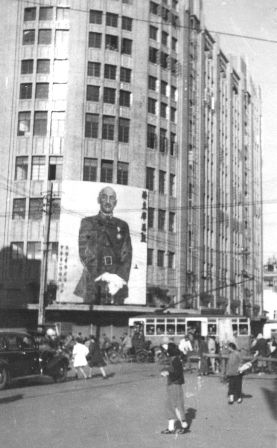
 Portrait of Chiang Kai-shek hangs on Sun Department Store in Shanghai.
|
Portrait of Chiang Kai-shek hangs on Sun Department Store in Shanghai.
|
Although the formal surrender of Japan to the Allied Powers was signed aboard the USS Missouri on September 2, 1945, it wasn't until October 30 that the 330th Troop Carrier Squadron flew into the still occupied Kiangwan Airfield, which was seven miles northeast of Shanghai, China.
Imagine our shock when we opened the doors of our C46 and were met by a contingent of armed Japanese soldiers. The officer in charge carried an unsheathed sword with which he saluted me. My right hand slipped across my chest to my 45 Caliber Colt Automatic Pistol in its shoulder holster on my left side. However, I withdrew this somewhat hostile action when, in very good English, he asked what orders I might have. Without hesitation, I instructed him to have his men discard their weapons in a nearby ditch. Upon his command, they complied and returned to their formation. I now felt that I was really in command of the situation. I ordered the officer to march his men back to their barracks to await further instructions. As they marched off, I began to breathe freely again.
During the ensuing few days, we saw many truckloads of our former enemy’s troops heading towards Shanghai presumably to board ships for their repatriation. Soon the only evidence of their former occupation of the airfield was their airplanes ranging from wrecks to ready to fly. It was interesting to see a few German planes among them, marked with the black cross. One aircraft that really caught my attention was an intact Japanese copy of our C47(DC3) Skytrain. The field also had several aircraft bunkers. Their open sides had the telltale vertical slots to accommodate a plane’s vertical stabilizer. Their radar facilities were housed in buildings designed to look like temples apparently to ward off destructive attacks. Damage to this airfield was minor, permitting our operations to begin shortly after our arrival.
Our cargos were now primarily Chinese military. Our 513th Troop Carrier Group was joined with the 443rd Troop Carrier Group, based at other Shanghai airports, to transport three Chinese Armies to Peiping and Nanking . This airlift was believed, at the time, to be the greatest mass movement of troops by air in history. It was completed in forty nine days of operational flying.
One of my trips that I vividly recall was transporting a contingent of Chinese Army Nurses to Peiping . They were accompanied by a Lieutenant Colonel in the Chinese Army. His name was Tso Wei Tse (pronounced “so we see”). The Colonel spoke very fluent English and I invited him up to the cockpit (“The Office”). We had a very interesting conversation which he apparently enjoyed as much as I did. He excused himself and said he would be right back. A few minutes later he returned and presented me with fine antique Samurai sword. He had taken it from a dead Japanese officer on the battlefield and wanted me to have it because, in this short time, he considered me a good friend. We never saw each other again.
The flights to Peiping always permitted good views of the Great Wall as we were stacked up for landing. We generally had several hours while our aircraft were being unloaded, cleaned and refueled. This gave us the opportunity to go into the city. I always enjoyed these trips as I could take more photographs. Although the Japanese had occupied China’s Capitol here for many years, there was no evidence of destruction. The civilian population seemed to go about their daily lives at their normal pace. The “Black Market” did flourish here and any American flyer was approached to sell any parts of his uniform or equipment The purchase price offered was usually a crisp new US $50.00 bill for each piece. These bills were not counterfeit. We always wondered where these entrepreneurs obtained them. The lure of this easy money sent a few Americans to jail. This dire action was usually reserved for the money changers who would buy thousands of dollars of Chinese currency in Shanghai at a low price and sell it at one of their flight termini for several times the cost.
We looked forward to the flights back to Shanghai and a run into the city and one of its very good restaurants. Food at Kiangwan’s Officers Mess was OK if we were too tired to make the effort to go to town. Our BOQ (Bachelor Officers Quarters) was a former barracks building used by the Japanese and did not provide us with the desire to spend much time in it.
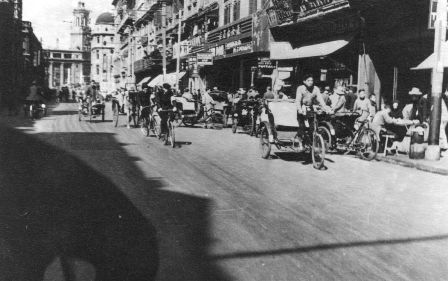
Shanghai was truly a cosmopolitan metropolis. It had a Chinese city, and extensive sections for the French, Russian and English and smaller areas for most other major nationalities.
ENLARGE IMAGE |
In one restaurant, I ordered Chop Suey or Chow Mein. The waiter excused himself and disappeared into the kitchen. When he returned he stated in his somewhat broken English “So Solly, no Chinee dish, we do not have”. I later learned that these dishes were born in America. The Sun Ya Restaurant on Nanking Road was one of my favorites. We would go there in groups of eight or ten and be escorted to one of the many private dining rooms and were seated cross-legged on the cushioned area around a large, low, round table. One of our favorite entrees was Roast Peiping Duck. We were told that these ducks were grown in small cages with only their necks and beaks protruding so that they could eat their fill of nourishing duck food. This produced a large, fat, tender bird in a relatively short time. The Shark’s Fin Soup, made from the cartilage of the fins of sharks, was delicious. Another delicacy was Bird’s Nest Soup with Pigeon Eggs. “Bird’s Nest “ is a gelatinous substance found in and around the nests of swallows in the rocky coastal regions of the South Sea islands. I have never had such fine Chinese cuisine in America as I found in Shanghai.
As we were all pilots who had flown the Himalaya Mountains prior to our transfer to Shanghai, we did learn a Chinese greeting there: Zeu pi nen san – "May your longevity be like the Hump"
One day I visited the Sun Department Store on Nanking Road. It was undoubtedly one of the largest stores of this type that I had ever seen. I purchased several items there in anticipation of my upcoming trip home—a green embroidered Chinese lady’s pajama suit with black silk trousers; a red silk tapestry embroidered with multicolored peacocks; and a silver pagoda with bells on each roof tip. That pagoda is still one of the prized acquisitions displayed in my home.
I also went to the Old Chinese City and purchased several wooden carvings that are still in my possession. One very fine carving of an ancient Chinese sage had quite a few Chinese Chops (letters & numbers) on it. I had previously met a Chinese scholar from the University who I asked to translate the markings for me. He told me that it came from the Ming Dynasty and was quite valuable. Some day I may have it appraised.
The waterfront of Shanghai on the Whangpoo River was called “The Bund” and was lined with large office buildings and banks. The docking area had boats of all descriptions moored there. Larger ships were anchored in the river. As I observed this, the term “shanghaied” came to my mind. I could visualize the times when crews for visiting ships were supplemented by Chinese entrepreneurs who owned a Junk. They would pick up and pile inebriated bar patrons into their boat and pole it out to the previously understaffed ships to sell their cargo. The ships then sailed out to the Yangtze River and the Pacific Ocean before they awoke to find that they had a new vocation or a new ship.
I now wish that I had kept a diary while I was there so that I could recall more of my experiences in this fascinating city.