 A PUBLICATION OF THE AMERICAN RED CROSS OF THE CHINA - BURMA - INDIA COMMAND
Vol. I No. 6 Calcutta, India October 10, 1943
|
3 More Clubs Open Doors In C.B.I. Theater
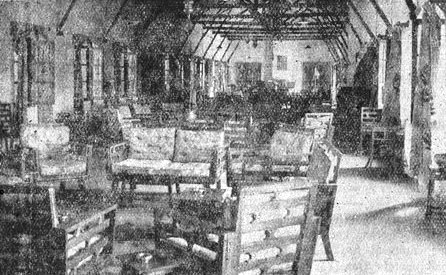
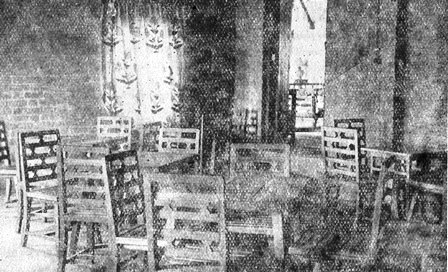
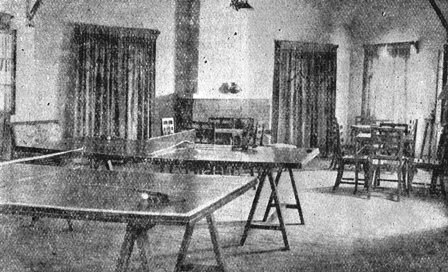
One new on post club has already opened in the Eastern India supervisorial region, and four more are due to open before the middle of October. A club unit under Alfred Zisser has already been christened Jungle Junction, and another up near the Burma border is already in use with temporary furnishings, reports Jack Conway, regional supervisor, after a field tour. The newest unit opened September 26th. Unexpected guests at the party were Mr. Conway, Miss Margaret Brown, canteen supervisor, and Bernard Gillespie, assistant canteen supervisor. The club has been organized by Miss Dorothy Mitchell who is turning it over to Janet Carey October 15 when Dorothy will report to headquarters for reassignment. Opening night show was a hit, Mr. Conway reports. Songs written by Cpl. Roy Brodsky (Contact USA, Candle Burning Blue and Lady in the Shoe) were featured by songsters Cpl. Henry M. Hubbard, Sgt. Sherrill Cummings, and Cpl. Robert A. Aylward. The orchestra consisted of Cpl. Fernand Arel (Guitar) and Cpl. James E. Stewart (Cornet). Assistants on the momentous occasion were Sgts. "Wings" Asson, Jack Underwood and Owen. Glen Price was master of ceremonies. Two brief speeches were made, one by Mr. Conway in presenting the club and one by the commanding officer in receiving it. The outlay of fine furnishings represented Rs. 14,000 and another score for Mohan Singh, who has decorated the majority of Amcross clubs in the area. The building is the first standard pattern on post club to be put to use: three rooms - a library, lounge and games room. A projection room is at one end of the lounge and the other end contains a stage. The overall of the building is 152' x 30'. A cafe 24' x 25' is attached to the building by a runway and a kitchen is attached to the cafe (16' x 25'). Duration Den and the new Calcutta Club are no better, say the boys. |
 Jerry Lennox gets a preview of some of the newly arrived "Victory" books.
The cases in the background also contain part of the shipment. Field Director Discovers That Life In India's No Cinch A day in the life of an American field director is anything but a cinch according to J. G. Dawson, acting field director of an upcountry post who has been on the job for the past seven weeks. "As soon as I got my post," said Dawson, "I was asked to take over the airport canteen. I put in an SOS to headquarters." Mary Beedon and Charlotte Van Stone arrived all right and immediately were hospitalized with sandfly fever. So Dawson got the help of Mary Beasley, hospital recreation worker, and together they slung out the first coffee and hamburgers. But cooking has been only a sideline. "Shortly after I arrived I got a request to hold first aid courses. In fact, I had been told I probably would before I left headquarters," stated Dawson. The C.O. at Dawson's post made first aid compulsory for all men detailed to the hospital. This is probably the only required first aid course in the theater. All sorts of men came, even several who refused to be interested. But one day everything changed. "A patient in the hospital needed artificial respiration," said Dawson. "It had to be done by hand. I had just finished giving the men their fourth first aid lesson which dealt with artificial respiration." The night Dawson discovered the need he helped the doctors till three in the morning. Two days later an SOS came again. "I just called the boys and put them to work," he said. Not only was the patient's life saved but the students got the real significance of first aid. Two of the erstwhile refactory students apologized and one offered to do his bit. One of them came up with a "Gee Whiz, Mr. Dawson, I certainly didn't get the hang of things before. I am certainly going to do some listening in the future." Dawson has been giving two lessons in first aid a week. He expects that the full course of 12 lessons will take 30 hours. The method follows that used in infantry training: explanation of terms; actual training as to treatment and recognition of symptoms; application of practical work and demonstration of training; discussion of hazy points, and examination. Dawson was even bubbling with first aid enthusiasm before he landed in India. He trained the crew of the ship that transported him and rendered all first aid required throughout the voyage. At home he did a number of things besides being a Red Cross volunteer: last heard of he was the personnel department of Pratt-Whitney Aircraft Corp. at Hartford, Conn. |
Books Arrive In
Bamboo Area
Dull hours have come to an end for G.I.'s in the CBI jungles if the 20,292 "Victory" books reach their destination.
After weeks on the high seas, 218 cases of books have arrived at Amcross headquarters - gifts of the American public. These books were collected through local Red Cross chapters in libraries, department stores and other places throughout the USA.
Previous to shipment, assortment was made by librarians and the resultant choice is high in quality and diverse in taste. One box which was opened immediately upon arrival, contained such books as: a Herman Melville thriller, a Jean Stratton Potter tear jerker, The Gregorian House by Frank Swinnerton, A Man Called Cervantes by Bruno Frank and A Vagabond Journey by Harry A. Franck.
All these books will be assorted and shipped out in the theater under the supervision of Mrs. Anne Maries Innes, Amcross librarian, who has previously been busy trying to purchase some 10,000 books locally and organize a library system. A graduate of a Danish library school and the American-French Library School in Paris, she is fast installing a standard system throughout the theater. She is assisted by Mrs. J. Page, wife of Flight Lt. Page, R.A.F. and Mrs. Gladys Whitburn.
Libraries are being established at all Amcross clubs. Dayrooms will draw their books from adjacent clubs. The library at the Calcutta enlisted men's club was the first to function with 175 books. Already 550 books have been sent into the field or are awaiting completion of club houses.
Kits made up of two steel trunks each containing 50 volumes, along with necessary stationary, have been organized. In each kit five volumes are completely catalogued. These will serve as samples to Amcross workers who will catalogue the rest upon their arrival at a post.
Mrs. Innes figures that each book, well handled, is good for 30 rounds. In addition to being godmother to Amcross' 25,000 or more books, Mrs. Innes has the job of establishing a reference library at headquarters of valuable books on cooking, recreation and entertainment.
For the next few weeks the new arrivals will be her chief chore.
THAT INCOME TAX MAN'S HERE AGAIN
The "pay-as-you-go" plan for collection of income tax which has already made inroads in some Amcross salaries by withholding at the source, will not apply to CBI workers in the future and deductions which have been made will be refunded, according to Fred G. Reed, Amcross financial cerebus.
The payment of income tax is now an individual responsibility of each Red Cross personnel and should be given close attention as to manner by which this tax shall be paid, explained Mr. Reed.
Annually, the tax forms will be received from the consular office and distributed by our headquarters office to each employee. The tax may be paid either by personal check on a bank at home or by U.S. money order. Others, who have left power of attorney at home, can fill in the form and send it home for filing.
CLUB INSPECTED BY AMBASSADOR
The name of another notable American was enscribed in the guest book of the Calcutta club during September when Clarence E. Gauss, Ambassador to China, paid a surprise visit to the club.
Enroute back to his post in China after a six month visit at Washington, Ambassador Gauss was a guest at several honorary functions here. After hearing people comment on the excellence of the enlisted men's club he decided to make a personal visit.
He was accompanied to the club by Consul Carl E. Christoperson who introduced the Ambassador to William D. Foster, club director.
A MAN WITH A GUN
In early pioneer days in America, a man with a gun in his hand had no doubts, as he knelt by the window of his log cabin, about what he was fighting for. He was fighting for his home and for his life, and the lives of his wife and children, there in the cabin with him. He had only his steady nerves, sure marksmanship and unfaltering courage standing between them and the enemy that tracked the woods.
It's a far cry from those days to the present, when the homes of America are being defended against far more savage enemies than ever before. Today, the man with a gun defends his home by leaving it; by becoming part of vast military units stationed in remote parts of the earth. He becomes a little cog in a huge complicated war machine. In every physical aspect of the situation he is remote and separate from those centers of his life and interests - his home and family.
But while the externals change, within the heart of the man, that which he defends is the same. An American soldier, as far from home as he can get - way up in a northeast frontier province of India - is worrying about the well-being of his young wife back in New England. For months while enroute by sea and land to his remote station, he has had no word from her. Before leaving home the physician in attendance upon his wife had calculated that their first born should put in an appearance early in June. It is now June, and the man with the gun, unafraid of the skulking enemy, is definitely worried and upset concerning his wife's welfare.
Thanks to his presence where he is and the presence of millions like him in different parts of the world, the wife's safety is not threatened by the malicious military might of our country's enemies. But there is a deeper worry which only the spanning of long distances, the direct communication with home, can ally.
On June 10th, back in a New England town, his child is born. The family asks the local Red Cross chapter to help them get the news to the father. They know that wherever the soldier is, the Red Cross will be able to reach him. A telegram flashes from Vermont to Washington, D.C. The Red Cross Services to the Armed Forces goes into action. The telegram joins hundreds being sorted out for cable and radio relay to all parts of the world - wherever soldiers, sailors and airmen wait - for wherever the U.S. Armed Forces are, there too will be a Red Cross Field Director.
In Central India on June 16th, at the headquarters of the U.S. Armed Forces, the message from Vermont is placed on the desk of one of these Field Directors. Army radio facilities have been placed at his disposal; Army personnel records are open to his needs. He quickly locates the soldier, writes a relay of the message, and sends it through army channels to his remote post. On June 20th, the man with a gun reads: "Mother and child doing well."
In this case we have in mind, it was a girl; the soldier knows her name - even how much she weighed. He knows his wife is safe, well cared for, thinking fondly of him. The remarkably efficient Army postal service will bring him further news of the child's well-being, but for now his initial fears have been allayed. He can pass out the cigars and play the proud poppa with a light heart.
The man with a gun now knows that between him and his wife is an unbroken chain of friendly fellow Americans - Red Cross and Army - who won't let him down. He knows what he is fighting for and for whom - and he isn't going to let them down either.
- DICK ELDRIDGE Field Director
|
Arc Light Gets New Editorial Combination If the ARC LIGHT leans a little on the feminine side this month, blame it on co-editors Adrienne Moore and Beatrice Offineer. For while Harry Houle, director of publicity, was away on a tour of the CBI Theater, the mice would play, and the two came up with this month's brain wave. Adrienne is an old hand on the ARC LIGHT, having been with the publicity department for several months. Beatrice, who is known as "Bee" to most people, is a recent importation from the states, hailing specifically from Akron, Ohio, where she was Sunday Women's Editor of the Akron Beacon-Journal. She is also a member of the Ohio Newspaper Women's Association and the American Newspaper Guild. |
THANKS!
Club Program Director
American Red Cross
Dear Mr. Kaufman:
I wish to take this opportunity to express on behalf of the officers and men of this organization, their sincere appreciation of the services rendered by your organization supplying assistance and material for our recreation room. Located as we are, the recreation room is our main source of relaxation and its facilities are enjoyed by all.
Sincerely,
Capt. DOUGLAS F. WATSON, VC., Commanding.
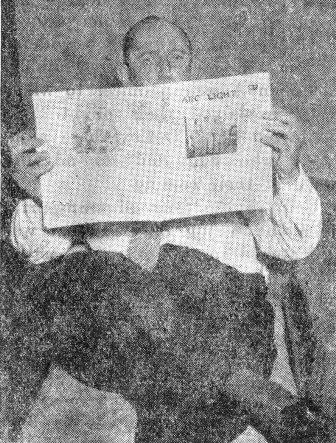 SENATOR RUSSELL OF ALABAMA
He Came, Saw and Left |
SENATORS GREETED BY NEW YORK GIRL
Anything can happen in India - and usually does. At least, that's the opinion of Miss Madeleine Northway, who recently arrived here with a contingent of Red Cross workers.
Miss Northway was standing in front of one of the leading hotels waiting for a taxi, when a private car drove up in front of her and stopped. Three men wearing the khaki uniform of the U.S. Army descended and came up to her smiling and with extended arms.
"Well, well, a Red Cross reception committee," one of them said, "How nice." The gentleman then introduced himself as Senator Mead of New York. He was accompanied by Senators Brewster and Holmes, who with Senator Henry Cabot Lodge, Jr., are on a tour of this war theater.
Miss Northway still doesn't know whether she should have admitted she was waiting for a cab, or claimed to be a reception committee. As it was, the only thing she could think of to say in her amazement was:
"I'm Miss Northway from New York City."
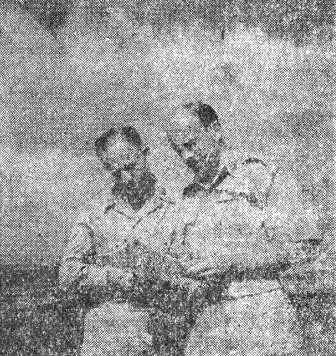 STAN WILSON & JACK CONWAY
They know the answers |
Workers In Hospitals
In line with plans for expansion of Amcross hospital service department and the arrival of its director, Mrs. Alta C. Hoover, recruitment has been going on for volunteer workers in the Calcutta area under the direction of Alice Todd. Working with Miss Todd, who is in charge of Amcross hospital work in the area, are Mrs. Marnie Hill and Mrs. Kathleen King.
Assisting them in their duties will now be 12 volunteers: Mrs. J. R. Bell, Mrs. Margaret Behrend, Mrs. Kenneth Patten, Miss Doris Wells, Mrs. Evelyn Henningsen, Mrs. Maude D. F. McClelland, Mrs. Frances J. M. Robertson, Mrs. Betsy Quinn, Mrs. Margaret Merrick, Mrs. Jean E. F. Menzies, Mrs. Lyla Thompson and Mrs. Zehra Hamlin.
Following their recruitment, a short training course which touched on hospital recreation, administration, ethics, therapeutics, surgery, orthopedics, libraries, medical service and hospital visiting was conducted by Miss Todd.
Gen. Stilwell Is Unexpected Guest At New Canteen
General Joseph Stilwell made an unofficial and unexpected visit to the Amcross canteen where Kathleen Gordon directs proceedings. With Gen. McCabe, he dropped into the canteen in time to sample the orangeade and doughnuts and express his satisfaction with the arrangement.
G.I.'s, after the surprise of seeing the Generals in their presence, crowded around to have rupee notes autographed.
An extension to the Amcross canteen was opened the evening of August 16. The addition consists of a British Army tent. The roof and bamboo supports are painted a deep blue and cushions for the chairs and settees are blue with red trimming.
The opening night found the hall jammed to the tent poles. Vince Carrozza and his Swingsters band presided over the jitterbugs. Popular songs were sung by Lt. Helen Schrope, while Pfc. Red Wells entertained with Irish ballads. S/Sgt. Joe Minter also sang, while Pvt. George Tatum had everyone laughing with his humorous impersonations.
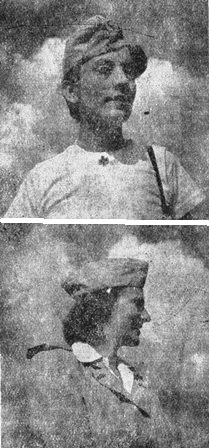 BEATRICE OFFINEER
CHARLOTTE VAN STONE |
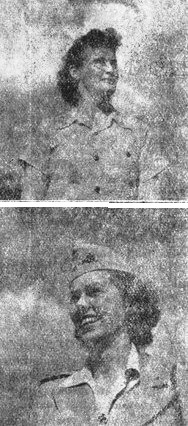 MAE OJA
FAITH TWINNING |
FLEET OF JAVA WAGONS
Clubmobiles have proved such a successful part of Amcross operations, not only in North Africa, but also the one which for the past months has functioned in Assam, that a clubmobile department has been set up for the extension of this facility throughout the CBI Theater of war. Mike Malkin, who initiated clubmobile work in the CBI area, has been appointed supervisor of this new department. He is assisted by Virgina Keadle.
At present one clubmobile is in daily use. Three more are almost ready to begin. Twenty new units have been requisitioned and should be ready to function in the next few months. They include 15 trucks and five station wagons. All units, except the station wagons, will have a piano. Common to all clubmobiles will be a public address system, cold drink and coffee dispensers and new records. They will serve, along with drinks, cookies, doughnuts, jam tarts and cakes. It is expected that the equipment for each wagon will cost around Rs. 6,000 to 7,000.
Mike also reports that clubmobile work is anything but a cinch. Each night the vehicle has to be on duty at a unit by seven o'clock. The post may be miles away from the base. Once Mike made a jaunt of 70 miles and back. That meant leaving at one in the afternoon and returning at four in the morning. A clubmobile worker never gets a sluggish liver either, judging by the roads.
NEWS SHEET SAVES SSO GAS RATION
Mike Malkin's Amcross news sheet has been dubbed a success such as Willie Hearst should be proud of, according to rumors grapevining in from the hinterlands.
This mimeographed sheet comes out every ten days or so for the benefit of Special Service Officers so they can know what ARC can do and provide. Gallons of petrol have already been saved, it is reported, by keeping SSO men on their own verandas instead of having them bounce in to ARC godown headquarters for equipment which isn't there.
The sheet has gone far towards minimizing inefficiency due to constantly changing units.
|
STATE PARTIES
State parties have become the specialty of a post up Dorothy Mitchell's way. Each Friday night quiz parties are held. One state team is pitted against another. One wiseguy asked "I was inducted in Nevada, but I was born in Maryland, can I come to both parties?" |
Duration To Go
A year in India was cause for celebration by a medical detachment stationed in a northern province. So Mary McGeoch, hospital recreation worker for Amcross, and some of the pill-pushers got together over plans for an anniversary dance.
Result: a local band volunteered to play anything from waltzes to boogie woogie. Streamers and bouquets of jungle flowers made a veritable Roseland of the day room. And G.I. mouths are still watering in memory of the hamburgers, doughnuts and coffee served at intermission.
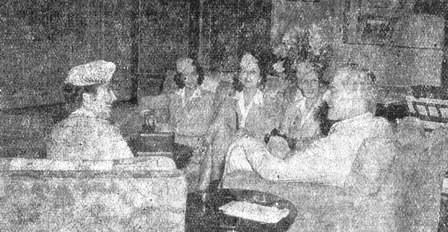 Four of the new Amcross workers were entertained at the Governor's palace by Sir John Herbert following their arrival at national headquarters.
They were, left to right, Mrs. Margaret Johnson Wright, Miss Mary Geraldine Adams, Miss Beverly Brown and Miss Esther Fennings.
Four of the new Amcross workers were entertained at the Governor's palace by Sir John Herbert following their arrival at national headquarters.
They were, left to right, Mrs. Margaret Johnson Wright, Miss Mary Geraldine Adams, Miss Beverly Brown and Miss Esther Fennings.
|
Into Arms Of Irate Sergeant
We know why they call it "Duration Den" now. Out of the monthly hurly-burly has come this choice tidbit:
The wife of a prominent British official visited the club late in August. A soldier, new to India, and evidently even newer to the niceties of social introduction, almost immediately asked her: "Gotta blonde daughter?" The British lady, fortunately, had a sense of humor and "sweated it out" to the last.
Very graciously she replied, "Why yes, but she is in Calcutta. When I was younger, I, too, was a blonde."
"Well," asked the Pride of American Wit, "how's about you 'n me hittin' the pavement for that India Coffee House?"
Politely assured that she was willing to "hit the pavement," our popular hero suddenly remembered that "the Major was waiting for him."
A kibitzer reports, however, that the gabby guy did have a date shortly afterward - with an irate top sergeant.
Walk, Ride And Float - - It's Tour Routine In China
"Thumbing" marked the first eventful excursion of Tiger's Den tourers. The Amcross station wagon went "phut' enroute to a temple and hitch-hiking had to be done as far as the river in order to get home, Virginia Fitzgerald reports.
But this did not dampen the spirits of the excursionists who subsituted a sampan ride for the temple and completed the journey by pony cart, army truck and rickshaw. The evening ended in Chinese chow in the city and a show.
The second attempt to reach the temple and successful. Some 15 men and officers went along.
|
FIVE FOR CHINA
Any moment now five Amcross girls will be joining the staff of China clubs: Alice M. Tiebout of New York City, a former decorator; Anna Kathryn Groves of Lexington, Ky., a former teacher; Elizabeth Heath of Oakland, Calif., a former physical education teacher, and Mrs. Jane Lee Williams of Mt. Kisco, N.Y., former recreation worker. A fifth appointee is Guida Richey. |
Four new hospital recreation workers are busy at their new posts: Miss Betty Murphy of Youngstown, Ohio who is located near the Hangar; Miss Caroline Bockholt of Downers Grove, Ill., who is in Jimmy Register's territory; Miss Ellen Denning of Denver, Col., who is now under the wing field director James S. Verner, and Harriet Gleason of Detroit, Mich., is working hard under the supervision of Alfred Zisser.
Empty Station Welcomes New Amcross Workers in North
An empty station greeted Ann Reddick, Frances Todd, Starr Giddy and Sally Street when they arrived at their first assignment post in northern India. Slightly bewildered at such a reception, they finally spied an American officer to whom they explained their plight. He contacted Capt. Oatley, base adjutant, who had no advance word of their coming.
Help in the form of transportation and a jug of ice water was dispatched to the pilgrims hastily, while the spreading word of "American girls right from the states" brought out a reception committee of G.I.'s in an enormous number. Meanwhile, Capt. Oatley and Lt. Toy, British officer, personally supervised the securing and setting up of cots and nets for the girls. A special dinner at the Amcross canteen was arranged by PFC's John Cassidy and John Gunday.
After the dinner the four paid tribute to the splendid cooking of Yakub Ali - Mohammedan cook with two wives and the contemplated marriage to a third.
All in all, the Assam reception, which looked doubtful at the start, turned out to be "teek hai."
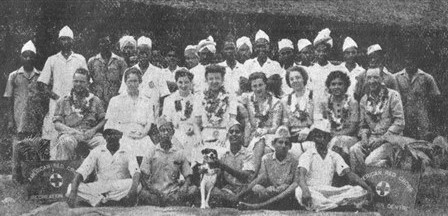 The menial staff of the Hangar surprised Mary Jim Barns with a farewell photographer and all the accoutrements. Left to right,
second row: Sgt. T. I. Carley, kitchen supdt.; Marie DeLorey, canteen director; Pamela Atkinson, program director; Mar Jim, retiring club
director; Mrs. Margaret Dene, secy.; Montrose Phillips, new club director; Mrs. Roma Kay, secy., and Hartsel Pace, field director.
The menial staff of the Hangar surprised Mary Jim Barns with a farewell photographer and all the accoutrements. Left to right,
second row: Sgt. T. I. Carley, kitchen supdt.; Marie DeLorey, canteen director; Pamela Atkinson, program director; Mar Jim, retiring club
director; Mrs. Margaret Dene, secy.; Montrose Phillips, new club director; Mrs. Roma Kay, secy., and Hartsel Pace, field director.
|
SO THE CENSOR’S JUST A BUM?
Hi, sucker! So you firmly believe all mail censors are moronic bums?
Always being on the alert to acquaint ourselves with the latest type of zoological mutation, we decided to beard the lion in his den. And lo, we discovered that the censor is human after all but sometimes he "gets that way" trying to keep you from making a sucker of Uncle Sam.
"Certainly our censorship looks dumb, but that's because all these incipient Hemmingways can't see beyond their own little letter," remarked the lion who in reality proved to be a gentle and docile soul.
It isn't what Joe Blow says, it seems, but how many times many Joe Blows say it. It's all worked out on a statistical chart at GHQ. So Joe, if your censor begins to treat your comas like hangnails and does doodles on your pages - watch out. And remember you made him that way by trying to be a wiseguy.
When you feel VERY unfriendly, for instance, because you can't XXX your letter to your girl friend remember that's because X's are "doors" to codes. And you simply make the censors yawn when you very, very cleverly write at the end of a nonsensical letter to the little wifie, "Now dear, remember how we arranged things when we left," hoping she can unscramble the screwball code you left behind.
If you are really a slippery eel there is always the code laboratory. And in case you think you can pull a fast one by writing the note in pre-Isilivich Eskimo, remember those guys can pull apart any code in 720 languages. The more complicated you make things the more apt the home folks are to receive your 1943 letter in 1944.
Most censors attribute G.I. efforts to fool the censors to egotism. G.I.'s they say, want the folks back home to think they are in the know.
Some censors even begin without a sense of humor, we admit, and wear their thumbs out on the rulebook but by and large they are good guys, though one censor we know who still has the strength to write home daily, admits that after a while censors begin to feel like a Section Eighter. Our acquaintance says he has just one desire after the war - if he is still sane - to get home, go to a beach with his family and just sit and stare at the ocean for six months.
There's just one compensation in the eight ball job; nine times out of ten the irate G.I.'s who come tearing into the office to jam their mutilated letters down the censor's throat stay to become friends.
And if it gives you any satisfaction to know it - censors have to have their letters censored too.
NIGHT TO DIRECT BUYING, DELIVERY
To achieve the maximum of economy in purchasing merchandise and to facilitate the distribution of all materials, a department of procurement and distribution has been set up by Amcross for the CBI Theater. William J. Night will act as director.
The department will at present have the responsibility of maintenance of all Amcross installations and equipment. The Amcross warehouses will also be under Mr. Night as well as the problem of arranging for shipment of goods.
Transportation, billeting and housing of Amcross staff are also under his supervision, though a shift may be made in the near future. Mrs. Eva F. Oates is taking over transportation from Mary Alice Smith who will go into the field.
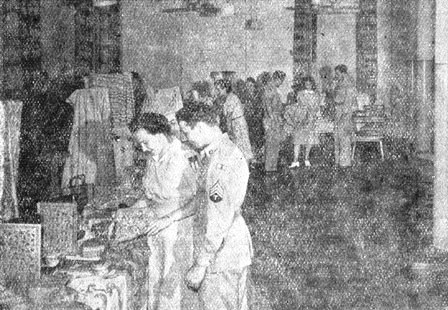 Around Rs. 11,000 worth of Christmas packets are USA-bound since the recent Amcross bazaar held at the Calcutta enlisted men's club.
Sponsored by the men's American Club of Calcutta, many volunteered their services.
Participating organizations and individuals were: Bengal Home Industries, Good Companions, Bengal Stores, Indian Red Cross, M. A. Mondal, Darjeeling
Tea Co., YMCA, Women's Home Industries and Statesman.
Around Rs. 11,000 worth of Christmas packets are USA-bound since the recent Amcross bazaar held at the Calcutta enlisted men's club.
Sponsored by the men's American Club of Calcutta, many volunteered their services.
Participating organizations and individuals were: Bengal Home Industries, Good Companions, Bengal Stores, Indian Red Cross, M. A. Mondal, Darjeeling
Tea Co., YMCA, Women's Home Industries and Statesman.
|
Big City Life ? It Stinks,
Says Jungle Gal
By MARTY WRATNEY
Danger is supposed to lurk in the tangled depths of the jungle and in the open stretches of country where army posts are located. But if you ask me (and nobody did) I'd say that the only Amcross personnel in real danger are those in the city.
If the transportation G.I.'s at camp dump you in a ditch, chances are it's a clean ditch with some nice fresh mud and a few rocks scattered around.
But when a city-bred taxi driver takes you for a ride, he scares you silly first, then picks a slow torturous death.
If his driving doesn't ruin your nerves, the eternal blatting of his horn will. These horns sound like a cross between an asthmatic cow and a hoarse goat.
The only satisfaction is that of sitting in the back seat and cussing out the driver in the best U.S.A. fashion, knowing full well he can't understand and take a poke at you.
And I'm not sure which is worse - dodging snakes and scorpions, or starved, diseased beggars.
The noise of the city would make a boiler factory seem like a morgue. My lungs can't enjoy the fullness of a deep breath while I'm in town. The air hits my nose first, and stops. My imagination works overtime on the trillion germs it must contain - the air, not my nose.
Of course, it's nice to come in town periodically to get re-civilized; i.e. a finger wave, hot bath, new clothes, shows. But deliver me from a permanent residence there.
DURATION DEN GETS ITS FACE LIFTED
By S/Sgt. William E. Barnum
Along with planned renovation of Duration Den in October, there has been almost a complete turnover of the ARC staff.
Mr. Smith, in discussing the plans for the overhauling of the club, said that during the process the club would remain open.
Special programs, such as quiz and variety shows and bingo parties have been making a great hit at the Den.
Another popular feature of the Den is the fortnightly enlisted men's forums. Last two speakers were Maj. Fred L. Eldridge, officer-in-charge of the CBI Roundup, and Mr. Frederic Ecker, chairman of the American Lend-Lease Mission to India.
The khaki-clads have recently turned into a sightseeing group. With co-operation of the Special Services Division of the Headquarters Squadron of the 10th USAAF, and W/O D'Orange, transportation officer, large groups have been going to many interesting spots. One recent trip was attended by some 100 interested soldiers.
Miss Betty Goldsmith, ARC hospital recreation worker and the ARC field director's woman office staff at this station, have been co-operating in these tours. One tour included a picnic in the country.
|
LANCE TRANSFERRED
A silver loving cup inscribed "To the Champion Good Sport" was given Irvin Lance as a farewell gift by his fellow workers at the enlisted men's club at a going-away party on Sept. 27th at the club. Mr. Lance, who has been program director of the Calcutta club, is going to the West Coast where he will be club director of two units. |
When G.I.'s want fresh vegetables - and there just "ain't none" to be had - there's only one solution to the problem . . . grow your own.
Mrs. Josephine Conner, director of a newly opened club in the eastern area, has launched an enterprise to supply cabbage, carrots, lettuce and tomatoes for the club canteen, according to Melvin Chase, program director.
Mel made a special trip to headquarters for gardening supplies. He reports that Mrs. Conner now has a gang of coolies preparing an acre of ground for planting in October. Tomato plants are already sprouting and almost ready for transplanting.
|
|

|
|
Calcutta To Have Second Amcross Club
The projected club for colored troops in Calcutta is at last underway. A building has been requisitioned and pending its acquisition and remodeling, plans proceed for entertainment of the troops. A staff has been appointed which will function until the colored Amcross personnel expected from the States arrives.
In charge of activities is Ruth Renner who worked with many of the men in this area before when she organized a similar club in the theater. Assisting her are Mrs. Rosalind Foo and Mrs. Vera Chatterjee.
Ruth is busy laying her plans for community parties, for the restaurant and soda fountain which will be set up in the new club, the information desk and games. If the projected site is available, there will be tennis, badminton and baseball on the spot. An orchestra is also being organized composed of men from various units.
The first venture under the Renner organization was a dance held at Dalhousie Institute, September 29th. U.S. and Amcross flags, colored balloons and palms were the decoration motifs and the 24 door prizes were a highlight. Cigarettes were awarded to the men and hankies with an embroidered red cross to the girls. About 250 men were present. The boys presented their own variety entertainment.
A second party was held October 8. This was a family affair at which bingo was featured. Only a short time was devoted to dancing.
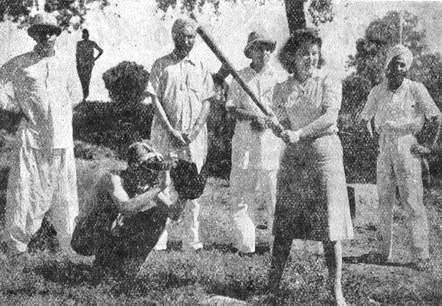 Ailine Whiteside gets ready to fan out while S/Sgt. William Barnum hides behind the catcher's mask at a recent Duration Den sightseeing tour-picnic.
|
Office Workers Guinea Pigs
For Student Cooks
A central canteen is now part of the machinery of Amcross headquarters office. Filling the dual function of serving lunches to staff members and preparing canteen workers to go into the field. The canteen is under the supervision of Mrs. Louise Hummer, a graduate in home economics who also was a technician in a Brooklyn hospital before her marriage. Mrs. Hummer's husband is a member of the American office of economic welfare located in Calcutta. When she and her husband were living in Delhi, Mrs. Hummer was connected with the British Ministry of Information.
The new canteen is being handled by seven men, six women and three sets of servants, all of which are now fully cogent about the taste and form of the American hamburger, pie, cakes and doughnuts. When their assignments have been settled they will be given further instructions suitable for their new work.
The training course began early in August with a week of lectures. Since then work has been purely of a practical nature.
Among those waiting assignments, some of which will be to railway station and mobile canteens in the Calcutta area are Mrs. Grace Downey, Mrs. Gladys Sury, Mrs. Elaine Chmelar, Miss Jean Murray, Mrs. Dorothy Hill and Mrs. Maisie Peat.
|
JOIN AMCROSS AND GET INTO BIG DOUGH Charlotte Van Stone and Mary Beedon have discovered that in working for Amcross girls can really get into the big dough. After a day and night of luxurious travel by rail they arrived at their post at 8:30 a.m., with two main objectives in mind - breakfast and sleep. Instead they were immediately escorted to the canteen and introduced to a tub full of doughnut mixing ingredients and several hundred pounds of hamburger. Rumors indicate that Charlotte and Mary mixed dough for the doughnuts and fried hamburgers by the hundreds from 8:45 until early afternoon. They nibbled hamburgers in lieu of breakfast. But the contingent of intransit troops who also had arrived that morning went on their way well fed. |
ROCHESTER’S GAIN IS INDIA’S LOSS
Sociability under a shower united two old friends in a north India district the other day. Keith Berkner, field director, lucky owner of one of the few such contraptions, came in from a hot day in the field dreaming of a cool shower. Grabbing his towel and soap, he entered the bamboo duplicate of a Roman spa, only to find it occupied. Growing darkness made any more than a speaking acquaintance with his G.I. companion impossible.
As he was leaving, the soldier asked the usual, "Where are you from?" "Rochester, Minn.," Berker replied.
"Well for gosh sakes, so am I," the other said.
A closer look revealed Berkner's old friend, Cpl. Vincent Gilchrist, whom he hadn't seen for two years.
|
PAPA DEPARTMENT
Lt. W. Wilbur Walton, a son, Wm. Woodrow, born August 27. S/Sgt. Thomas P. Kolenda, a daughter born August 3. Lt. John Frank Lassa, a daughter, Susan Cecilia, born August 14. Pvt. James V. Smith, a son born June 27. Lt. William Thomas McCoy, a son, William Jr., born August 14. Pfc. Felix Antedomenicko, a son born August 10. Pfc. Harold C. Coker, a daughter, Ruby Joyce, born July 25. Lt. Thomas C. Schiebel, a son, Thomas Walter, born August 31. Capt. Alfred Allessi, a daughter born August 17. Cpl. Paul E. Klarer, a daughter born in September. Pvt. Irvin Whitington, a son, Irvin Jr., born September 3. |
Aud. And we ain't your uncle!
Ldr. Give me a Bakshish, sahib?
Aud. Jao!
Ldr. I am just a poor man, you rich American John.
Aud. Jao! Now we are the hep cats, so take a tip jack and back track. No Bakshish!
Ldr. Now the rains are falling. Please Sahib hear me calling, Bakshish.
Aud. Gharri-walla. No Bakshish!
Ldr. Horse is nearly dead; he needs to be fed, Bakshish.
Aud. Gharri-walla. No Bakshish.
Ldr. All right, sahib, I take you to Garden Reach - no Bakshish?
Aud. No Bakshish! Now if these cats didn't have the nerve to jive a tip before we served, we wouldn't mind a bit giving them Bakshish, No ! No !
Ldr. First take you to Garden Reach.
Aud. And that is a Killer.
Ldr. Please give me a Bakshish, Sahib?
Aud. Say what?
Ldr. I am just a poor man, you rich American John.
Aud. Hey! Cut it out! Now here is five rupees, so take this tip and button your lip. Bakshish? No Bakshish?

Ollie Jane Hudson and Jean Cottrell, after a delay due to illness, are now busy working at their new post - Monsoon Inn.
A recreational warehouse has been set up at Mike Malkin's hangout. Part of the building is also used as a club operations building. The storing of equipment makes speedy delivery possible to nearly all new units which arrive. Mike left his territory for Calcutta on the verge of initiating Clubmobile No. 2.
Amcross staff assistant, Kathleen Wister, no sooner arrived at her new post than she was listed among the local casualties. While trying to find her way back to her barracks after duty in the recreation room, she fell into a slit trench and sprained her back.
Duration Den has initiated a States' register for G.I.'s. Soldiers are asked to sign their names and local addresses under the heading of their home state.
Nancy Nash - jitterbug extraordinaire - thought after one lesson with Arthur Murray in New York that she could cope with the bounciest of "rug cutters.'

Enjoying the fresh air of Khanspur. |
Joy Hensall has gone to the west coast with Helen Latif on a survey.
Caroline Campion, proud godmother, and one of Amcross' local recruits, has just learned that her godchild, Miss Angela Ogilvie of New Delhi, has become engaged to Lampton Berry of the American Mission. Mr. Berry was secretary to William Phillips, the president's personal representative, and recently accompanied him to USA where Mr. Phillips assisted him in obtaining the necessary dispensation for the engagement from President Roosevelt. He will marry Miss Ogilvie after the war is over.
Who'll nurse the nurse when the nurse needs nursing? Such was the recent dilemma of Edith Dowley, headquarters visiting nurse, when the flu bugs knocked her out for the count of five long days.
Walter Lichtenstein, field director who has been assisting Barney Butler, Calcutta area field director, has been assigned to Delhi where he will assist Dick Eldridge. Glenn Auten, a recent arrival from USA, is now assisting Barney Butler.
Betty Randal isn't sure whether her ayah is suffering from hypnotism or auto-suggestion. Anyway, Betty was suffering the ill effects of an inoculation the other day, and - like all women - indulged in a bit of weeping. The ayah, squatting next to the bed, saw the tears, and began to cry also. "We had a wonderful weeping session," says Betty, "and both felt the better for it."
Mary Stewart has gone to an Amcross Hill Station post.
Stanley A. Haw and James S. Verner, new assistant field directors, have gone to their eastern India posts. Haw will be assisting Keith Berkner while Verner will be in charge of a new set up.
Louise Buckley has been assigned as a hospital recreation worker on the west coast. "Lee," as she is popularly known, comes from Denver, Col. She was secretary to Erskine Caldwell and Margaret Bourke-White.
Miss Dorothy Martin, who is now at headquarters after 8 months in Assam has been appointed assistant to Beatrice Lynch, supervisor of the Western Region.
Janet Day Carey has gone to a provincial post shepherded by Malcolm Muchmore.
Zorika Wheeler, locally recruited British worker, after two months in northeastern India and one month as mistress of Amcross' Clubmobile unit, returned to Calcutta the middle of August to resign from her Amcross activities. Zonika says she feels that her duty belongs with her own British troops and now that Amcross reinforcements have arrived, she has taken the fatal step.
Mrs. Martha May of Annapolis, Md., has joined the personnel department as assistant to Mrs. Ruth Grimshaw.
Mr. Norman Winestine, until recently director of the Amcross rest camp at Shillong, arrived in

We wonder what they're saying. |
Mary Adams has been appointed staff assistant under Melvin L. Chase, field director.
Ailine Whiteside, Duration Den's greeter in chief, recently met a group of new arrivals at the front door. They exclaimed, "We can't believe what we're seeing!" looking at the club.
Pvt. Ward Arneson of McVille, N.D., however, had another opinion. He commented: "Hell, it's Ailine, our little Georgia peach."
It's the jungle circuit for Cpl. Arden Clark who has joined a traveling unit from the BESA theater in the eastern area as master of ceremonies. The traveling revue will play to both American and British camp audiences.
Mary Jim Barns, after 8½ months in India, several of which were spent as club director of the Hangar arrived at headquarters the end of September. Within 24 hours she was appointed club director of the nearby completed on-post club in the Calcutta area.
Assisting Mary Jim will be Marion Storms of Kansas City, Mo., who will be acting assistant director; Elizabeth Randall of Clarksville, Maryland, who will direct programs; Diana Whitburn, a local recruit and staff assistant, and Miss Caroline Campion who will be housekeeper.
Send A Sari By Santa To Sugar - BY BEATRICE OFFINEER
Hey G.I.'s. You know that Christmas is just around the corner and you'd better be thinking about a gift for that gal back home. Sure, we know - you've been sending her trinkets and souvenirs - but if you really want to please her, send her a sari. Yes! One of those thingumabobs that the Indian women wear.
Maybe you don't think she'd like it. Take it from us - she will. What with good materials hard to get back in the States, she'll love having a gown unlike any other woman's in town.
But that gal friend who is used to picking up a little ready-to-wear number in Macy's basement, may be a bit bewildered by the six to nine yards of material that pops out of the package.

|
She could have it cut up and made into a super swanky evening gown with enough left over for a couple of beach costumes. Chances are, however, she'd appreciate knowing how the Indian girls wear a sari - and do likewise.
Here are a few hints you might enclose in the package so she'll know just how to go about this business of wrapping one.
First, she does the blouse that is worn under the sari. It is usually of a contrasting material - a print if the sari is of a solid color, or vice versa. Then, the end of the sari is placed at the natural waistline and wound tightly about the hips twice.
When the wrapping is done, the sari should fall into a skirt extending from the waist to the ankle. Five deep pleats are

|
The material that is left is then brought over the right shoulder, across the back, up under the left arm pit, across the front and under the right arm pit. Once again up over the back and over the head.
A tip on the types of saris to buy. Cottons are plentiful in the stores back home, so try to purchase one of those brocaded cloths or embroidered ones.
If she's really chic, the girl friend will add those trinket bracelets and rings you've been sending her to the costumes and be the last thing in glamor. Because, believe it or not boys, while you may be so tired of seeing saris you could scream, they would cut quite a swathe in New York - not to mention Podunk and Milwaukee.
|

|
Nancy Nash - Shopper for G.I.’s
From Harpers to Bazaar - the saga of Nancy Nash, Amcross personal shopper for G.I.'s.
With Christmas approaching - and those holiday packages for home must go out this month - Nancy has taken over the job of bargain hunting for the soldier unable to do the shopping himself.
In order to give a preview of possible purchases, Nancy held a bazaar at the Calcutta Enlisted Men's Club on Sept. 28, 29, 30 and Oct. 1. For weeks preceding the event, she was to be found every day haunting the market, getting goods on consignment from the Bengal Home Industries and the Good Companion shop.
The native markets, according to Nancy, are a far cry from the Fifth Avenue shops in New York that used to be her hang-out. At home she was a fashion copy writer for Harper's Bazaar magazine, where she edited the college fashion supplement for six months. She was also assistant to Mary Faulconer, famous fashion designer.
A native of Wisconsin Rapids, Wisc., Nancy graduated from Smith College.
It is possible for men in the field, in addition to Amcross workers, to send requests to Nancy for purchases. So far she has had but one mishap. An officer, stationed in the north, ordered a pair of shoes while visiting in Calcutta and was unable to pick them up before returning to his post. He sent an S.O.S. to the Amcross and the inquiry was given to Nancy. She picked the shoes up at the cobblers. But before she could send them away, the ants had held a picnic in the glue holding the heels in place. She's now looking for some good cobblers tacks to repair the damage.
To the feminine Amcross workers, Nancy gives these instructions. In ordering a dress, submit a sketch or return the one printed here on this page with scale of measurements. Nancy will return swatches of material with price included from which to choose. A money order for full amount including dress-making must then be forwarded before work can be begun.
Ruth Walks Home From Plane Ride
Ruth Moore will go down in history as the girl who walked home from an airplane ride. Ruth was being flown in a cub plane from Monsoon Inn locale to a nearby station when, short of gas, they jammed into a thunderstorm. Risking the last few drops they barely flew over a hill and landed. While the pilot stayed and took care of the plane, Ruth had to walk through the jungles with a local inhabitant to get petrol. Once obtained, they went to their destination, arriving hours late amid a flurry of anxious telegrams.
|
Station Wagon Loses Wheel;
Sightseers Spend Day Sitting - BY BETTY HEALY
Cpl. James Moore wanted to see the rainiest spot on earth so we packed our lunch and ourselves into a station wagon and started off with a party of seven.
We arrived at Cherapunji on an "unusual day" - not a drop of rain and a beautiful clear sky.
First we went to the dak bungalow where we had our lunch, using the utensils supplied there and also took tea. We wanted to see the falls. There are many in the vicinity but we got directions to the biggest one and started off.
About half a mile later the car began to jerk and boom! It stopped and one of our wheels was lying at the side of the road. Examination showed that the lugs had sheared off, making it impossible to put on a spare or drive without repairs.
We had noticed a Post Office back on the road a little way, so Sgt. Steve Mahaley of Johnstown, Pa., the driver, and I started
|
In order to get help that day a wrecker would have to get through the lower gate of the controlled road by 4;15 o'clock.
Still no answer!
About this time we discovered that there was one civilian car in the place, that of a Mr. Murdock. We sought him out and he agreed to lend the car if we would replace the petrol which we used so he could drive until his next ration arrived.
I went back to the telegraph office where Steve was still tapping and trying to arouse Shillong. The Indian operator who had long since reached a state of exhaustion, was incapable of understanding why we were in such a hurry.
Finally Shillong answered and our message went through but there was no telling when it would be delivered at the Shillong end. So we went back to the car and waited. Some of the boys, determined to see the falls anyway, started off on a five mile jaunt.
Mr. Murdock later picked them up.
At 5:30 there was no sign of help so we decided to accept Mr. Murdock's offer. Sgt. Mahaley would not leave the station wagon.
When we got to Ferndale the C.O. greeted me with the words:
"Are you trying to wreck all my transportation?"
He was very nice about the whole thing and was glad no one was hurt. Meantime Steve spent the night with the car, a can of salmon, a packet of dates and a tin of milk.
BAMBOO GENIUS
T/5 Stanford Bleything who before joining in the fight for freedom operated a printing shop strictly for the "carriage trade" in Portland, Ore., certainly misses his peacetime profession.
Though he hasn't lead type to play with, Bleything is taking up wood carving in a big way and gives vent to his hobby by carving name plaques on bamboo. Elsie B. Connolly, assistant field director, received the first sample of Bleything's work. Within two weeks he received twenty requests for similar plaques from officers and other Red Cross workers.
“PATSY” LURES TALL TEXAN TO THE DOGS
"Patsy" and "Ragtail" are an inseparable combination up Monsoon Inn way, according to Barbara Walz. Patsy is a 4 week old white puppy picked up in Calcutta for one rupee. "Ragtail" is a tall Texan.
"Ragtail" rises at 2 a.m. for Patsy's early morning feeding. And at 10 each night he comes around to Monsoon Inn, where the boys usually bring her for the evening, and in his slow Texan drawl says "Come on Patsy, it's time to go home," and off she goes to the barracks.
Band Leader, Singer Help Cheer G.I.’s
Professional entertainers, who have left the bright lights and gay quarters for G.I. barracks are doing their bit to bring sweetness and light to the recreation programs planned by Pamela Atkinson.
Pvt. Louis Stahl, Gary, Ind., had his own band in civilian life. An accomplished musician, he plays both the piano and bull fiddle for fellow G.I.'s.
Sgt. William Harnew, Oak Lawn, Ill., used to air his voice over NBC in Chicago. He was also in the cast of two army shows, "Pass the Ammunition" produced in Pueblo, Col., and "Military Secrets of 1942" at Tucson, Ariz. Bill had just been signed to appear on Wayne Van Dyke's "Breakfast Hour" when his overseas assignment came.
Coaches In Quandry: Teams Are Depleted Each Week By Army
BY HENRY E. ISOLA
It is becoming more and more evident that the pig-skin battles this season will provide the greatest scrambles football has ever known. Not even the boldest or goofiest of all prophets can pick this or that team to win since no one can tell you how many men will be left from week to week.
Teams that opened their training seasons with large squads may find ten, fifteen or even twenty absentees answering the roll call before the season is very old.
The writer does not believe any spectator will notice a big slump in class as long as most of the teams are fairly matched. The plater can look just as good as a stake horse, until he runs against the stake horse. He can give you as much excitement - and as many thrills.
A year ago, around this spot, you could pick out the strong teams and know that the weaker squads might as well have gone in for table tennis or hop, skip and jump.
But it is different today. Outside of military schools like Navy and Army, football will be 50 percent of its former
|
Holy Cross labored for years to get Harvard on its football schedule, succeeded for 1943, and then Harvard cancelled its whole gridironing program . . . Starting in 1901 and continuing through 1905, the University of Michigan won 29 straight football games, was tied once, then won 27 more in a row before losing . . . Harold "Red" Grange playing for Illinois against Michigan, in November 1924, carried the ball only five times. He scored five touchdowns. His runs were the following distances: 95, 67, 56 and 45 yards in the first quarter and 15 yards in the fourth quarter . . . In 1929 "Moon" Mullins, Notre Dame fullback, gained only 1 inch against Navy during the entire game. But it was enough to score the game's winning touchdown. The nose of the ball was 1 inch from the goal line when the play began. Mullins, on a plunge, just reached the line with the nose of the ball. He failed to gain any other time he carried all afternoon.
ANSWERS PHONE - IT’S FATHER-IN-LAW
Meeting a cute babe in the midst of the woods is one thing but meeting your father-in-law is another. Anyway, C. A. Calvin, of China Relief isn't kicking. Leaving his wife and child at their home on Staten Island, New York, he recently arrived in Chungking. His wife was born in Honan where her father, Dr. Fedde, was a missionary. Dr. Fedde was also on his way to China, but Calvin didn't know it. "I just picked up the phone and got Dr. Fedde on it," reports John Nichols, "and told Calvin someone wanted to talk to him." Surprise wasn't a suitable word for Calvin's reaction.
COBRA vs CORPORAL
"Killer" Jones is the new nickname of Cpl. Rexall Jones, since his bout with a five foot jungle cobra. The venomous reptile slithered into camp one night and was engaged in a fight with the camp's pet mongoose when Cpl. Jones interceded - on behalf of the mongoose, no doubt. The cobra escaped under a loose stump. Cpl. Jones stood by with a club while other men moved the stump with a rope. As the cobra came out, Cpl. Jones deftly dispatched him with said club.
Cpl. Jones is with the medical detachment and hails from Andalusia, Ala.
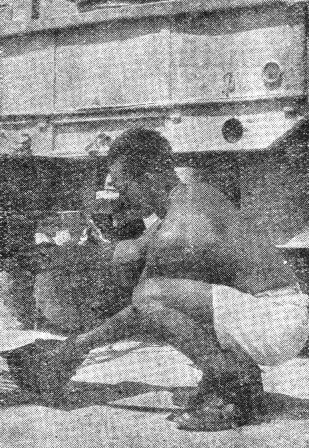 T/5 Sam "Gunga Din" Caldwell and auxiliary supply truck that saved the opening of an Amcross day room when the main water pump broke down.
|
|
Pvt. Harold "Frenchy" de Rosia, Wayne, Mich., is a wizard with the spoons, and we don't mean in a chow line. He was known in the States as the "Yodelling Kid" with the famous Kentucky Mountaineers, and played the spoons as part of his act. He has spent the best part of his time in Canada touring to different towns with the Mountaineers. At the present time he is entertaining his fellow G.I.'s. |
TO WORRY PACE
The "gremlins" in the form of a broken water pump on the main supply line almost stopped the opening of a new day room for the colored troops of a central Indian Ordnance Depot. Almost - but not quite.
For the "Gremlins" failed to reckon with Hartsel Pace, Amcross field director, and his able assistants Pamela Atkinson, Mary Jim Barns and Marie deLorey. For with the help of Lt. Potts, program supervisor and Special Service Officer for the colored troops, an auxiliary supply truck was brought forth and water supplied.
The day room came into existence when Lt. Potts realized that the men needed a rest from building construction, handling of bombs, machine gun ammunition, and other lethal paraphernalia of war. So he called on Mr. Pace to see what assistance the Red Cross could give.
A building was furnished by the government; the furniture, ping-pong tables, games and other incidentals being purchased by Mr. Pace.
Under the direction of Lt. Potts and the Depot soldiers' committee, composed of Sgt. Lott, Cpl. Davis, and Pvt. Lynch, a program took shape for opening night. Highlight of this program was a quiz contest in which the pay-off was in honest to goodness American cigarettes.
Colonel Wins Cobra Battle; Loses Trophy
Col. York N. Pitkin, C.O. for an Assam medical battalion recently wrote finis on his king cobra story.
The episode began when 15 families of cobras decided to take up residences around the bashas of the battalion. The medicos went on a snake hunt and all were routed except one old King Cobra; he adopted the Colonel's basha as his court room.
The end came when the guards of the organization were startled the other night by a commotion from the Colonel's room. Four guards rushed in and wrote the final chapter on "Old King Cobra's Autobiography" with "Tommy" guns - much to the disappointment of the Colonel, who wanted the 13' 5½" skin for a trophy. Right now it's only good as a sieve.
