|

December 17, 1945 |
|
The Yenan Communists have not come up to their advance billing. A sure American policy could bring the peace China and, apparently, Russia want by CHARLES J. V. MURPHY |
Mr. Murphy, one of LIFE's editors, has just returned from a three-month visit to China. In this article he reports on the current trouble in China and the background of American policy there.
As General of the Army George C. Marshall made ready to leave for China to be the new ambassador, Secretary of State Byrnes suggested smoothly that American policy would of course continue to support the established government of Generalissimo Chiang Kai-shek - "The most satisfactory base for a developing democracy."
To an American fresh from China this sounded about right, a nonweasleing statement of intent suited to the immediate emergency in Asia and American responsibility in the Pacific regions where our military power has smashed up the old balances. But it certainly was not the policy in October and November.
The Army declares a furlough
In October, American policy going into China met American policy going out. Thousands of soldiers, whose job (except for the small air force) had been to service and train the Chinese, jubilantly filled their barracks bags and crated their souvenirs. "Home by Christmas" was the password from the almost deserted flying fields of Chengtu, beyond Chungking, to the PRO offices in the Broadway mansions on Suchow Creek in Shanghai. Except for air-lifting four Chinese armies into North China, auctioning off the left-over equipment, setting up a small professional training mission and one or two other odd jobs, the Army figured its job was done. In fact its commander, Lieut. General Albert C. Wedemeyer, a fine officer, was not in China at all but in Washington, reportedly helping to reorganize the Army in China. Ambassador Patrick J. Hurley was there, too, debating whether to return to Chungking or resign.
Discipline dissolved like starch in rain; ATC schedules turned whimsical; the pilfering of Army supplies for sale to the Chinese black market became a joke; the gin mills, the White Russian girls, the jade shops of Peiping and Shanghai, after the monotony of Kunming and Chungking, beckoned irresistibly to private, colonel and beribboned general. It was quite a spectacle.
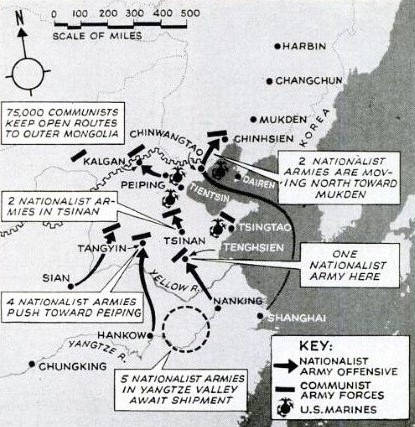
While the Army was declaring itself a furlough, the 1st and 6th Divisions of Marines, straight from the battlegrounds of the Western Pacific and in full battle regalia, were moving into North China, at Tientsin, Peiping and the port of Tsingtao in Shantung. Officially their job was to disarm the Japanese troops in North China. But in the back of their minds was the idea that they were also expected, on behalf of the Chinese government, to maintain law and order - no fooling.
I visited the Marines in Peiping, Tientsin and Tsintao in mid-October, and the contrast between their spit and polish and the Army was too glaring not to be noticed. of course, they were combat troops, with a brisk, businesslike air. Many of their officers had served in China before the war
|
In November I saw the Marines again. Their morale was shot. They were fed up with the Chinese. They were interested in only two things: "When do we go home?" and "What the hell are we doing here anyway?"
It was hard to believe that the occasional crack of ancient German Mausers in the Tientsin suburbs had produced this change overnight. The Marines know a dangerous war when they see one and the splutter in the Chinese countryside scarcely raised an eyebrow. What unstrung the Marines was the bewildering clamor back home to get the troops out of China and the crossfire of China's civil war. Marines get homesick, too, and when the erroneous report reached Tsingtao that even the New York Times wanted them out, they can hardly be blamed for thinking Americans had no business in China.
The unhappy fact is that just about this time the American Army commanders in China, at a down-to-brass-tacks conference in Peiping, discovered they were at a precipice. Unless they stopped the withdrawal or at least slowed it down, there would really be a civil war in China.
“A queer business”
For the generals knew what the public did not know; that the popular picture of the Marines being caught in the middle of the war between the government and the army was more metaphorical than real. It is not the Marines but the Japanese who are in the crossfire. Presumably, Japanese soldiers, after more than eight years in North China, also get homesick, but, more than three months after their government capitulated, 225,000 of them, by order of the Chinese government, are still doing armed garrison duty, in North China, in Shansi, Hopeh and Shantung provinces. Whereas the Marines are responsible for the railroad between Tientsin and Peiping and a short stretch south of the Great Wall, the Japanese are holding long stretches of the principal trans-China railways - between Peiping and the Yellow River, between Tientsin and Tsinan, as well as parts of the Lunghai between Lienyunkang and Paoki Wei, the Tungpu in Shansi province, and the Tsinan-Tsingtao line.
So far the total American casualties directly attributable to the civil war are two Marines slightly wounded by stray bullets and one killed. One young U.S. Army captain was shot down on a railroad platform two months ago by Communist troops on no apparent provocation. The Japanese, on the other hand, in 1,000 brushes a month with Communist guerrillas since the end of the war, have had nearly 3,000 casualties.
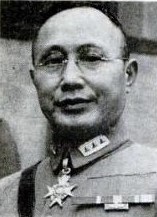
In short, the Japanese army in China, although much reduced, is still a going concern. General Okamura is still in his headquarters in the Foreign Office in Nanking, close by the Chinese headquarters. He has his own sentries at the entrance, his own communications system to his commanders. But, of course, when the commander of the Chinese armies, General Ho Ying-chin, summons Okamura responds at once, bowing respectfully and accepting orders humbly. Hard-bitten General Robert B. McClure of the Chinese Combat Command, has witnessed this tableau several times. "You have here a situation," he explains wryly, "where a defeated enemy is being employed to maintain law and order. It's queer business."
But the conditions that produced this queer arrangement, once understood, help to explain the riddle of China - a riddle which this brief report cannot hope to unwrap.
Last summer the Communist trouble seemed under control. Chiang Kai-shek invited the Communist leader, Mao Tze-tung, to leave his Yenan stronghold and come down to Chungking to try to settle their differences. For a long time the Generalissimo was loath to make the gesture. "Let him come to Chungking like any other Chinese citizen," he said. "Why should I have to treat the Communists as though they were a foreign power?" In the end, however, he unbent - "May I humbly invite you ... This involves our national welfare. Yours most anxiously ..."
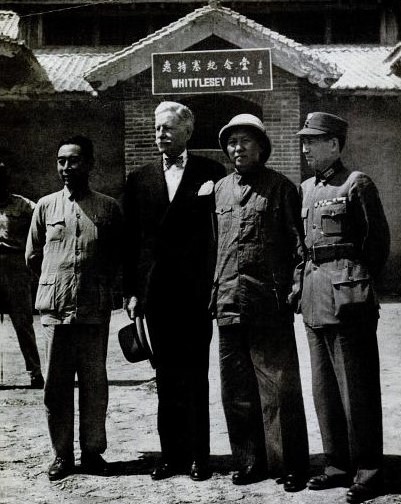
Mao Tze-tung arrived late in August in a U.S. Army transport airplane provided by Ambassador Hurley. The crowd waiting at the airport on the bank of the Yangtze River saw a heavy-set, somewhat stooped man dressed in a rumpled, blue cotton uniform without insignia - a man with the heavy, immobile face of a peasant. Over the yellow wine that night the head of the state toasted the rebel. "I hope we can have the cordial atmosphere of 1924" - a reference to the days when they marched together in China's revolution.
In the course of the next six weeks Chiang and Mao met a number of times and when they were not meeting, their representatives were. The Communist leader proclaimed, "The war is over. We have entered the period of peace ..." His chief aide, Chou En-lai, said, "Mr. Chiang is not only the leader of China today. It is our hope that he will be the leader of China during the period of peace and national reconstruction."
By the end of September even the cynics in the Press Hostel, who had scoffed at the idea that Mao Tze-tung would ever come to Chungking or that, if he came, he would ever make terms with his enemy, had decided prospects were bright for a settlement.
The negotiations continued into October. One day wise old General Wu Te-chen, secretary general of the Central Executive Committee of the Kuomintang and one of the powers of the government, remarked dryly over his green tea, "You must understand of course that with the Communists politics is merely a means to an end. They never give up their real objectives." And about the same time the wheelhorse of the government negotiators, General Chiang Chun, governor of Szechwan, was confessing, "The Communists have not relented...."
What the Communists want
Nevertheless, right up to Mao Tze-tung's return to Yenan on October 11, the illusion of harmony was preserved. At a farewell dinner he made his memorable promise to settle all unsolved issues "by discussion and no other means."
But already his troops were on the march in China and some time between Oct. 8 and 11 an order went out to the Communist field commanders to start tearing up the railroads and block the government's reoccupation of North China.
What went wrong? Who started the shooting?
As to the issues: the Communists made a big point about popular elections, free speech, free press, punishing of traitors, freedom of political prisoners and so on. China could certainly stand plenty of reform. But the Communists have no monopoly on democracy. Chiang Kai-shek and the government and the Kuomintang also want these fine things. The Communists and other opposition parties were accorded legal existence. Censorship was already abolished in Free China and practically nonoperative in the hitherto occupied area. In Chungking one of Chiang Kai-shek's former political prisoners, a left-wing professor who became a minor cause celebre, boasted of his lecture audiences and press clippings. Chiang's cabinet, however grave its faults, made up of rich and poor, socialist and conservative, was and is the most liberal and honest in recent Chinese history. And the government, if the Communists had not asked for a postponement, last month would have called the long-promised constitutional convention to end the "political tutelage" (one-party Kuomintang government) and institute representative government. "The highest ideal of the National Revolution," the Generalissimo cried on V-J Day, "is the participation of all people in national politics."
The real issues had nothing to do with the abstraction of democracy. As the price of participating in the government the Communists demanded absolute political control of five provinces north of the Yellow River (Shantung, Jehol, Hopeh, Chahar, Shansi) in addition to their so-called border regions of Shensi, Kansu and Ninghsia and the vice-chairmanship in six others (Suiyuan, Honan, Anhwei, Hopeh, Kwangsi and Kwangtung). This added up to working control of Inner Mongolia and all North China north of the Yellow River, a strong minority position in the populous provinces between the Yellow River and the Yangtze. Moreover, they would be astride all the land approaches to Manchuria, in the government of which they demanded representation.
|
In six weeks of bargaining the government negotiators succeeded in cutting down the political demands e provincial governorship (Shansi) and six vice-chairmanships (all south of the Yellow River), and the army demands by about half. The government was prepared to yield Mao Tze-tung three or four provincial chairmanships - but not in contiguous provinces - and with the proviso that the Communist choice would be a worthy and popularly elected administrator. It was further prepared to leave him with 20 divisions, but insisted these could not remain the standing army of the Communist provinces but must eventually enter the national forces. "To have done anything else," said Governor Chiang Chun, "would have meant setting up a special region in North China. This we could never accept. It would be just another kind of warlordism."
The Communists say that for them to give up their armies in advance of constitutional reform would be to invite annihilation by the Kuomintang reactionaries. Hence their intransigence can be partly explained by fear. But a power urge - no weaker certainly than they attribute to Chiang Kai-shek - would seem to underlie their gantic insistence upon political hegemony in North China apart from an adequate popular test. Plainly the major issues raised by the Yenan Communists have little to do with communism as political theory. And if they mean what they say about unification by any standards of political reasonableness they are fundamentally wrong when they insist upon a separate army. That can only lead not to one China but two - antagonistic in philosophy.
The race for weapons
Perhaps on this account the Chungking negotiations were doomed to fail. An air of unreality pervaded them from the start. Mao Tze-tung boasted of an army of 1,200,000 men and 2,200,000 militia; by Yenan's claim, the regions which its armies had liberated contained more than half of China's 400,000,000 people. Yenan claimed all North China, and in the Yangtze Valley its New Fourth Army was supposed to have the cities of Shanghai and Nanking surrounded.
But all the while the argument went on over control of China, it was plain to everyone that neither government nor Yenan was in physical possession of the really important parts. The war's sudden end found the government armies chiefly crammed in the west and south, ready to spring for the south China coast. The Communists, although spread over North China from the Yellow River bend to the sea, were actually diffused over the countryside. The Japanese had all the cities, ports and railroads (which were then running), they had the Yellow and Yangtze River Valleys. And the Russians were in Manchuria.
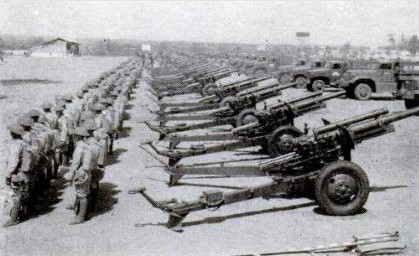
With the Japanese control theoretically eliminated, a race developed for physical possession of these regions in advance of the final showdown. Another prize was also at stake - the weapons of the Japanese army. The Japanese had about 1,100,000 troops in China - many more than was realized. They had, in addition to rifles, huge stocks of heavy machine guns, fieldpieces, trucks, signal equipment. These weapons were not indispensable to the Nationalist armies, 39 of whose divisions had been equipped or were being equipped with U.S. arms. What the government mortally feared was that the Communists, who immediately demanded they be allowed to disarm the Japanese in North China, would reach them first.
Two moves were made by the Chinese government, or on its behalf, to head off the Communists. General MacArthur in Tokyo ordered the Japanese to surrender only to Chiang Kai-shek's army. Then General Ho Ying-chin warned Japanese commanders they would be held "responsible" for law and order in the regions in which they were garrisoned and for keeping the railroads open until the government forces arrived. In other words, the Japanese were to hold on to the title deeds of occupied China until government troops arrived.
Naturally, this arrangement was repugnant to Chiang Kai-shek and with the idea of ending it as soon as possible, he asked the U.S. to help move his armies. Sometimes the Chinese demands seem crazy but that may be because these people think nothing is impossible for Americans. Chiang Kai-shek asked Wedemeyer to move 85 armies (about 3,000,000 men) by air. The American air staff, when it recovered from the shock, pared the number to four (about 92,000 men) and promised to complete the job by Nov. 15. And the Navy, in addition to putting down the Marines in North China, agreed to pick up several armies on the south China coast and move them by sea around the Communists to Manchuria and the Shantung peninsula.
General Ho Ying-chin used the American air lift to pass four crack American-equipped and American-trained armies over the heads of the Communists into Shanghai, Nanking, Peiping and Tientsin. He got them into all these cities without a fight. The much-advertised battle for the Yangtze never materialized.
Development in the north
Meanwhile, without American help, General Ho has pushed other armies, by rail and on foot, into the north. Their parallel movements he likens to the teeth of a comb. Four armies under General Sun Lien Tsung, following the Pinghan railroad (Peiping-Hankow), have crossed the Yellow River and are within 200 miles of Peiping. There, for the present, they are stalled, partly by 100,000 Communists or so barring the way, and by most of the railroad track ahead being destroyed. To the east, along the Tsingpu (Tientsin-Pukow) railroad, two more armies have pushed into Tsinan, capital of Shantung, and a third army, still farther to the east, has reached T'eng Hsian, in the same province. Compared to the U.S.-sponsored divisions, these are all second-rate troops, but so far, considering the state of the railroads, they have done pretty well.
But the maneuvering so far has been more intense than the fighting. The only real fighting has been in the remote province of Suiyuan. There two months ago 80,000 Communists surrounded a much smaller government force which had got around their rear, but so far they have not been able to administer a coup de grace. However, this action is apparently a subsidiary one - a Communist operation to hold open the exits from Yenan into Outer Mongolia, managed by friendly Russians.
The big battle for North China, if it is ever fought, will probably start in Shantung. The Marines have noted feverish activity throughout the innumerable hills, and the Chinese high command is pretty sure that several large bodies of Communists armed with Japanese rifles have crossed the Gulf of Chihli from Darien in junks, landing at the Communist-held port of Chefoo.
So far, despite their head start, the Communists have not achieved any notable successes in Shantung except to occupy Chefoo after the Japanese garrison departed and to rip up the railroad tracks. But the Japanese must be given credit for saving the province for the Central Government. So long as they were along the railroads and in Tsinan and Tsingtao, the Communists kept their distance, giving the government armies time to slip in.
However, this "friendly enemy" arrangement, as might be expected, produced its embarrassing moment. In October, as soon as his troops were ashore, General Shepherd of the 6th Marines served notice on the Japanese commander to surrender his force on a certain date. The detachments in Tsingtao were to be disarmed in a showy ceremony on the public playing field; those along the railroad to Tsinan were to march into the port. But on the eve of the ceremony somebody asked who would then guard the railroad. Not the Marines, said General Shepherd. The only government force on hand was the mayor's private army, which was afraid to leave the city. The Japanese stayed on the railroad.
Last month the Japanese general, apologizing for his presumption, complained that his men, being confined to passive positions, were being annoyed by Communist snipers. He appreciated the restraints laid upon the Marines by American public opinion and sympathized with the conditions delaying the arrival of the Chinese regulars. If Shepherd would allow him to be a little more aggressive, he guaranteed to end the Communist nuisance in short order.
|
North of the Great Wall the situation developed with the alarming twists and turns of an E. Phillips Oppenheim novel, and for a few anxious weeks Ho Ying-chin was afraid of losing not only Manchuria but two armies to boot.
Originally Chiang Kai-shek expected no trouble with the Russians in Manchuria. At the signing of the Sino-Russian pact in August, Stalin agreed to evacuate his army within three months after the Japanese surrender. There was no question then of the Chinese Communists getting in first, for none ever managed to crack the Japanese cordon.
The first unfriendly sign was noted in October when the Russians curtly refused to let government troops land at Dairen, whence a fine railroad runs to Mukden. Chiang Kai-shek decided not to make an issue of the rejection. With the Russians offering no objection, he made arrangements to go ashore instead at the smaller ports of Yingkow and Hulutao. But on arrival at Hulutao the transports were greeted by small-arms fire. The Red Army, giving no notice, had departed and Chinese Communists held the port.
A shiver of apprehension ran through the high command in Nanking. Did this mean the Russians as they withdrew were turning Manchuria over to the Yenan Communists? Intelligence reports were somber: long columns of unarmed Communist conscripts moving north through the Great Wall into Manchuria from Hopeh, presumably in search of weapons; other groups, this time armed, moving back. Even more sinister was the chill that descended upon the previously friendly exchanges between the Chungking mission in Changchun and Soviet officials. The Chinese could not find out whether the powerful Kwangtung Army had been disarmed or what was done with its weapons. And they were desperately anxious to know what the Russians were doing with the puppet armies of unreliable allegiance which were believed to total more than 700,000 men.
The race for Manchuria
Denied Manchurian ports, the 13th and 52nd Chinese Armies put into Chinwangtao at the end of the Great Wall, brushed aside negligible Communist resistance and started up the coastal railroad to Mukden, 250 miles away. The withdrawal plan called for the Red Army to be out of all Manchuria south of Harbin by Nov. 25 and the rest by Dec. 1. And from the first fear that the Russians might not want to leave Manchuria, the Chinese high command became alarmed they would leave too soon, allowing the Communists to slip in behind.
"If this business is to be done properly," a Chinese general complained, "the Russians must wait for us to catch up. I cannot imagine their being oblivious to the significance of their action."
With less than 70,000 men on the Mukden road, Chiang Kai-shek took the only steps that would give him Manchuria without battle: He appealed first to his American friends and to Russia. From Wedemeyer he asked an extra air lift for another army as far as Changchun - a request which Wedemeyer had to refuse, his authority ending at the Great Wall. The Chinese asked for Lend-Lease air transports with volunteer American pilots - a transport version of AVG. While Washington was mulling over this proposal, Chiang Kai-shek took the only alternative left. He asked Stalin to hold the Red Army in Manchuria a little longer. Stalin obliged - at a price, judging by Chungking rumors. The new withdrawal date is Jan. 3.
If the situation below the Great Wall is weird, how much weirder is the one above, with the Russians holding the title deeds to Manchuria against their ideological cousins.
Many strategists think that Chiang Kai-shek has bitten off more than he can chew. It is argued that instead of trying to take North China and Manchuria simultaneously he should have been content with North China, moving up along the two railroads, clearing the country as he went, fastening his grip on Peiping and Tientsin, and gradually introducing the long-promised economic and political reforms.
Wedemeyer and McClure spoke up for the conservative approach, even at the expense of the temporary loss of Manchuria. But the Generalissimo, after weighing the alternatives, decided to try for both and his reasons, as paraphrased by one of his aides, went like this: "Militarily, it is dangerous to go into Manchuria. We may lose our two armies. Politically, we have no choice. Manchuria is part of China - and the restoration of our territorial integrity is one of our fundamental war aims. Not to attempt to take it back would be an admission of incompetence."
Moreover, the government sees a special danger in Manchuria. A General Staff officer speculated, "Today the Communists are armed chiefly with rifles. They do not have many heavy machine guns. But Manchuria contains tremendous stocks of weapons, as well as one of the world's finest arsenals. Suppose the Communists should squeeze half a million men across the Great Wall. Suppose they should recruit half a million puppets. A million armed men, a first-class arsenal - it is something to think about."
The eventual outcome of the struggle for control of China is still in the balance, but the stakes the Chinese Communists are playing for are discernible. It is to build a military base around the Japanese-created heavy industry in Manchuria; to make a thick political and economic buffer out of North China; to keep the region between the Yellow River and the Yangtze as a friction area. "It is very simple," says General Hsiao Yu-shu, General Ho's chief of staff. "A castle, a wall and a moat."
Chinese intelligence, admittedly scanty, places the present Communist strength, counting nonideological partisans, at about 600,000 men, collected in half a dozen big pockets; between 300,000 to 400,000 are armed with rifles of one kind or another. Since the Japanese surrender they appear to have collected between 50,000 and 150,000 rifles, as well as 30 or 40 Japanese fieldpieces, which were first put to use, to Chiang Kai-shek's alarm, in the "little battle" for the Suiyuan corridors. According to Marine Intelligence they have also "enlisted" several thousand Japanese troops.
The Communists and the future
But over the long pull and in the absence of direct help from Russia, the Communist position is hopeless. The government has the prestige; it has the more experienced commanders, the better troops; its U.S.-equipped divisions carry much more firepower than the Communists' best; and of course it has plenty of bombers and strafers which, in deference to American opinion, it has not used. On the military scoreboard the Communist armies have fallen far short of their advance billing. Despite their claims of having carried 69% of the weight of the Japanese army during the war, they do not appear to have been any more than a nuisance, though a constant and nagging one, especially along North China railroads, to the Japanese. (Okamura says total Japanese casualties in seven years' skirmishing with Communist bands were only 25,000 killed and wounded.) In the so-called "civil war" their lack of military success so far seems almost queer. It is the same on the political side. The much-publicized underground armies in the cities are as yet inert; no deep people's note of defiance has sounded from the myriad villages in the Peiping plain although there are plenty of Communist soldiers around. The fact has somehow been overlooked that North China is not natively communistic; nor are the Communists natively North Chinese. In the last decade they have wandered all around the periphery of China - first the southeast, then the southwest and northwest to Yenan. Now once again they are folding their tents and moving into Inner Mongolia, another fortress.
This much seems clear: if we stop helping the government and if the Russians cut off Yenan, the government in time will finish the Communists, although the war would be futile and desultory. If we help the government over the crest and if the Russians meanwhile can be assured we seek no special advantage inside China, then the Communists will have to be reasonable or face a quick end.
What assume we must clash with Russia over China and/or Manchuria? In this situation the Kremlin seems ready to do business with Chiang Kai-shek. It did so last summer, when T. V. Soong went to Moscow, and again last week over Manchuria. The logic favors the assumption that Russia desires peace in Asia - a peace impossible without a unified China. And it is quite possible that the Russians all along have been expecting us to do more; that the flurry over Manchuria was a hedging operation. And if meanwhile the international left-wingers keep after Chiang Kai-shek's head, the apparent inconsistency may only be a bargaining technique. The Yenan statesmen, with their talk of a ten-year war, of not needing or ever having any outside help, would seem to be discounting that possibility.
In the end, of course, if China is ever to be a great nation in a substantive sense, the Chinese must resolve this question of national unity among themselves, preferably without further violence. There is plenty of room for self-improvement. All China pulses with a pent up reform that neither the Kuomintang nor the Communists alone can satisfy.
|
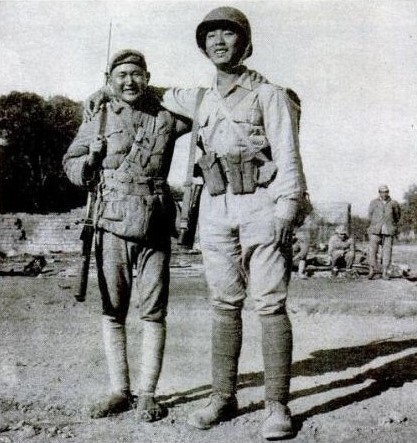
American apologists of the Chinese Communists have painted a picture of a prosperous, happy agrarian democracy under popular Communist auspices based on popular government spreading through the Chinese villages. It is no longer possible to accept these pictures as wholly authentic. Instead, as the Communists make ready for battle, come tales of the wholesale killing of village elders, the ruthless impressment of young men, an apparently calculated program to rend the centuries-old fabric of the Chinese social life as constructed around the village and the family. They seem to have abandoned their interim war policy of a slow, deliberate communizing village by village. In destroying and blockading the railroads they have inhibited the paths of China's reconstruction; a terrible economic problem has been made nearly insoluble. Even so sympathetic a journalist as Mr. Tillman Durdin of the New York Times left the Communist region around Kalgan with an uncomfortable memory of scared, silent people and confident commissars.
But whatever happens to the Communists - whether they eventually enter the democratic state supposedly desired by all Chinese or whether by one of those peculiar accommodations common to Chinese politics they are allowed to persist as a splinter state - their impress will remain on Chinese life. As no other party has done, not even the Kuomintang of Dr. Sun Tat-sen's great hour, they have awakened the political consciousness of the Chinese peasant; in many parts of China they have broken the crushing grip of the rapacious landlord and the tax collector. At their best the communists introduced a genuine democracy into the bottom of Chinese life - the bottom where the hundreds of millions are. And the very fact of their survival, beginning with their epic retreat from Kiangsi and Kwantung to Yenan, attests the strength of their human if not their doctrinal roots.
But the flaw in the Yenan case as regards democracy is the flaw in the Communist case everywhere; the Chinese Communists decline to submit to the first condition of representative government: the risk of a possibly disadvantageous majority. To be sure, the same charge has and can be made against Chiang Kai-shek. He, too, has postponed many, perhaps too many, elections. He, too, is on trial, not only in China but before the world. The fact that he has started down the path of reform leaves the Communists unmoved. They say he is too late with too little; too fearful of disturbing the ancient restraints of Chinese life. A wise old revolutionary who marched under Dr. Sun Yat-sen says, "Ah, but that is not the weakness of Chiang Kai-shek alone. It is the weakness of China." The point is that Chiang Kai-shek is prepared to put his government to the trial of popular elections. And although Chinese politics extends over extremes as wide as those found in other countries, only the Communists refuse to take him at his word.

Adapted by Carl W. Weidenburner
from the December 17, 1945 issue of LIFE.
Portions copyright 1945 Time, Inc.
FOR PRIVATE NON-COMMERCIAL EDUCATIONAL REFERENCE ONLY
TOP OF PAGE ABOUT THIS PAGE MORE CBI FROM LIFE MAGAZINE CLOSE THIS WINDOW
VISITORS