|
by Mary Robinson
This is the story of an African American nurse's service during World War II. The story covers Olive Lucas' time in the Army Nurse Corps between 1942 and 1945, much of it in the China-Burma-India Theater. Originally published in five parts by The Talbot Spy, the entire series is presented here on one page. Individual parts can still be accessed using the links below. Scroll down to begin, or go to one of the parts highlighted below.
|
|
|
|
|
|
|
|
Preface
This writing project began with a phone call from my father in 1998. He asked me to see if I could find anything about my Aunt Olive’s time in the Army. Olive was one of my father’s six sisters. I grew up with stories about her, she was a woman ahead of her time, a woman who was not willing to settle for the limited options available for a small town girl. My father’s request was a result of Olive having a stroke. She recovered nicely but she lost all memory of her time in the Army.
Olive was among the first Negro nurses admitted to the Army Nurse Corps in World War II. In searching for information I learned that most of her records were lost in the 1973 fire at the National Personnel Records Center in St. Louis, Missouri. Eighty percent of those Army service records for those discharged between November 1912 and January 1960 were lost.
The search for information about Olive provided a history lesson I had not expected. It has turned out to be one of the most rewarding things I have ever done. I have no letters or diaries from Olive, only many photos and two postcards to her family, but the Internet has given me an amazing amount of information. My dilemma was how to put this information together. It is a family story but more than that it is a story of American history, African American history, women’s history, and more.
A memoir writing class turned out to be the answer to my dilemma. This six week class with the Academy for Lifelong Learning which at the time was part of the Chesapeake Bay Maritime Museum, allowed me to organize the information I had found in my research and put it into a format that created a story. I decided to write this piece in the first person as a way to allow Olive to tell her own story. I owe a special thanks to Glory Aiken the leader of the class and to the others in the class who encouraged me to find a way to share this story.
The information I used came from U.S. Army records, books, websites, newspapers, interviews and personal narratives of nurses who were in the Army Nurse Corps at the same time as Olive, which was 1942 to 1945. I learned that the military experience for nurses who served at the same time in some of the same places was different depending on your race, but most of all I learned that Olive is a wonderful example of ambition, courage, resilience and a zest for life.
Part One
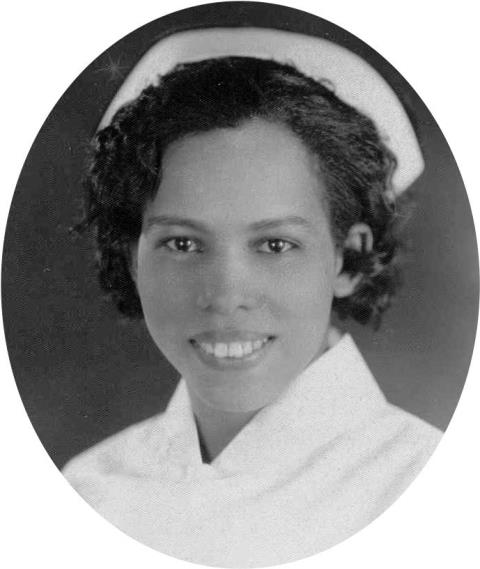
My name is Olive Lucas, I was born in Westmoreland County, Pennsylvania on October 31, 1908. I am one of six girls and two boys born to John and Mary Lucas, My family lived in Meadville, Pennsylvania, a small town just south of Lake Erie. My father was a maintenance man for the Meadville Water and Light Department. His small salary was stretched to provide for this large family, which meant that college was not an option for his children. After graduation, my older sisters, Leona, Ethel and Marguerite, went directly into service in the homes of local wealthy families. When I graduated from high school in 1927, I was desperate to leave that small town where opportunities for a young Negro girl with dreams were extremely limited. My parents were concerned that my inability to live under “White Folks Rules,” would be a problem. To this day I am so grateful that they understood that I was hungry for more than that small town could offer. They allowed me to move to Pittsburgh, Pennsylvania to stay with my sister Ethel and her husband Pat.
By 1932, I had saved enough money to enroll in the Harlem Hospital School of Nursing and I moved to New York City. I graduated from nursing school in 1935 and took a nursing job at Seaview Hospital on Staten Island, New York. While I enjoyed my work at Seaview, it had become routine and I was ready for a change. By 1942, Japan had attacked Pearl Harbor and the U.S. was fully engaged in World War II. Because of the nursing shortage then, the military considered implementing a draft for nurses. In 1941, the recruiting office of the Army Nurse Corps predicted they would be short 1,000 nurses by 1942. My friend Wanita Davidson and I believed this was a perfect opportunity for us to leave our jobs and join the Army Nurse Corps, so we went to our local Red Cross Chapter to enlist.
Our attempt to join the Army proved to be more difficult than expected. Because of racial discrimination in our country, the Army put in place a quota system for Negro nurses. In 1941 the quota allowed for only 56 nurses. In addition to the quota system, recruitment of nurses was done by the American Red Cross. In order to be a member of the Red Cross, you first had to be affiliated with the American Nurses Association. Negro nurses in southern states were denied affiliation. Negro nurses in northern states who were professional registered nurses and members of the Red Cross, were eligible to join the Army Nurse Corps.
The local Red Cross chapter in New York was not consistent in their admission policies. Wanita and I showed up to register and were turned down on more than one occasion, but I was determined. On August 25, 1942, I received my Red Cross badge number 658-A, and my New York State registration number 071635 and I became a member of the Army Nurse Corps.
One of the biggest incentives for me to join was the pay scale for nurses in the Army. Depending on the years of service, the pay ran from $70 a month to $130 a month after nine years of service. In addition to the salary, there were medical, dental and retirement benefits that were far better than I could receive at Seaview Hospital or any other civilian hospital. The biggest incentive of all, was the opportunity to see the world, meet new people, and learn the latest techniques in medical practice. I was young and eager and determined to follow this opportunity to wherever it might lead.
Part Two – Fort Huachuca, Arizona
Here I am, 2nd Lieutenant Olive Lucas, a member of the Army Nurse Corps. Our bus leaves at nine tomorrow morning headed for Fort Huachuca, Arizona. I and five other nurses will be on that bus, headed for our first Army assignment. It is summer in New York and it is so hot that there is steam rising from the pavement. I love the city, but have to admit, I am looking forward
|
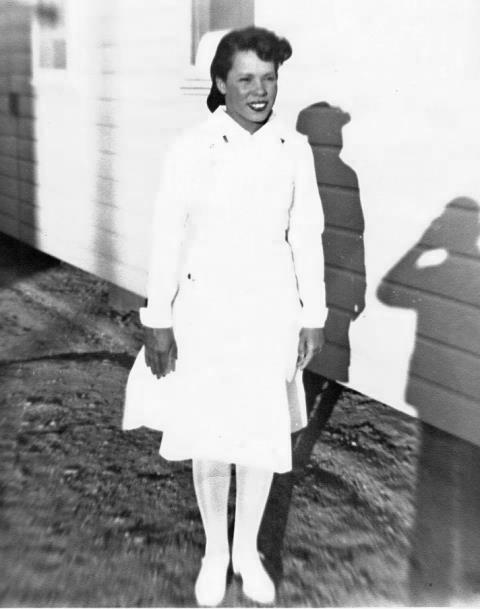
It is August 25, 1942, and here I am in this isolated place in the middle of the Sonoran desert. The bright lights of New York have been left behind and I find myself here amongst the poisonous snakes, spiders, chiggers and a host of other desert creatures. On top of all that, there is heat, sand, dust and constant winds. Just stepping off the bus and my shoes are covered in a mix of brown dust and sand. I thought New York was hot, but this is the kind of heat that is going to take some getting used to.
I know the official Army policy calls for segregation of all base facilities, but it is a little disconcerting to see that every single area of the base is segregated. Civilian quarters for locals who work at the hospital, service clubs, officers’ clubs and most importantly, both hospitals are segregated. Hospital No. 1 is staffed by and serves all Negro personnel and their families. Hospital No. 2 serves all other personnel, their families and civilians. Fort Huachuca is home to between 17,000 and 20,000 Negro soldiers, nurses and other personnel. Two combat units of Negro soldiers, the 92nd and 93rd Infantry divisions are based here at Fort Huachuca.
I never imagined a hospital this size on an Army base. The hospital covers several acres with various units connected by miles of corridors that are over a half mile in length. I quickly realized the best feature of the whole hospital is that the connecting corridors are covered, which offers protection from the unrelenting sun, wind and sand. To give you an idea of just
|
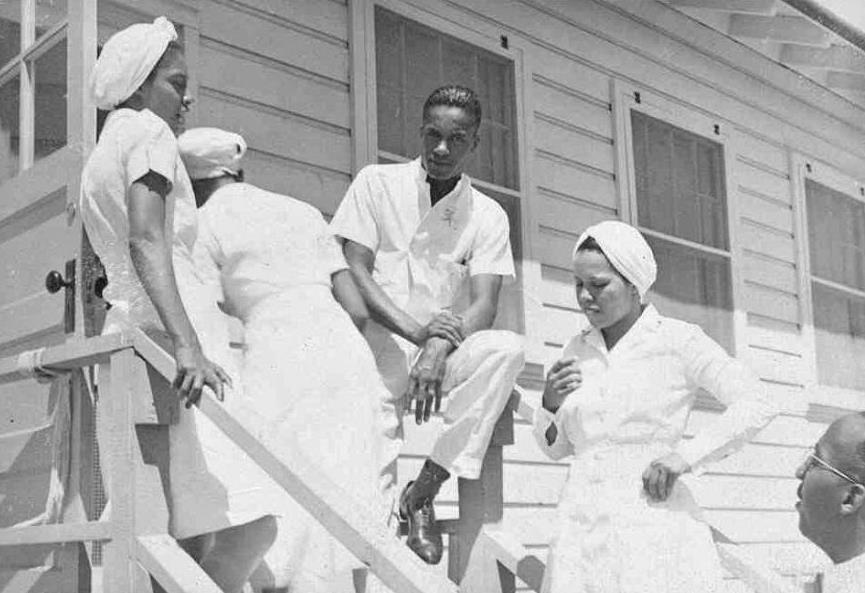
Today began with basic training. We had to perform all of our duties wearing our civilian clothes, even the drills in the middle of the day, in August, in the desert! Our basic training will last six weeks. I can’t imagine how we can do six weeks of this in our civilian clothes. The explanation given was that the Army is in transition from changing our uniforms from the Red Cross uniform to an Army Nurse Corps uniform. The components of basic training will cover medical and military training in the form of drills, map reading, tent pitching, obstacle and infiltration courses, as well as physical fitness.
It is probably a good thing that the hospital complex is so large because the soldiers, nurses and other Negro personnel will most likely be spending the majority of our off-duty time on the base. Off-base businesses and restaurants do not serve Negroes
|
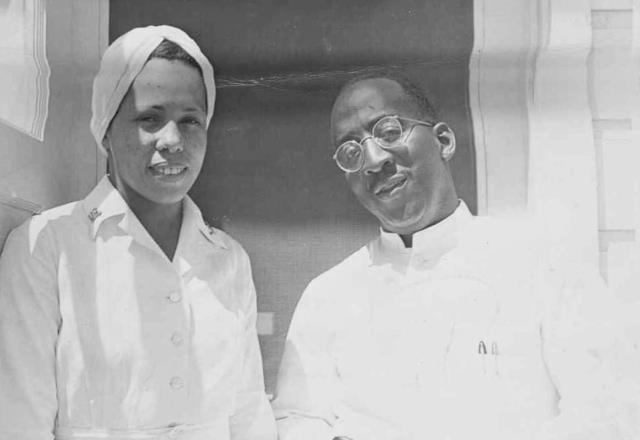
The WACs are coming! This is the best news we have had in weeks. The Women’s Army Corps is a unit that does a whole variety of jobs. They do everything from doing repairs for military vehicles to being responsible for entertainment and morale boosting on the base. There is a rumor that they will be the ones to create an officer’s club for the Negro officers at Fort Huachuca. The current club, The Lakeside Officers Club, is not open to Negro officers. The new officer’s club will be a great place to hold the shows that the USO provides. Entertainers like Lena Horne, Count Basie, Billie Holiday and many more will be able to perform and the Negro audience won’t need to be sitting at the back of the room.
I enjoy reading the magazines and newspapers in our library. There are always issues from the Negro newspapers from all over the country. The Chicago Defender, The Pittsburgh Courier, The Crisis Magazine all have war correspondents that are writing articles about Negros serving in all areas of the war. The experience of Negro nurses can be different from one area to another, but some things are unique to this group of nurses. I remember a comment from a nurse who when asked her view of the role of Negros in the war replied, “I find it exciting, and I am learning so much, but at the same time I find it to be the most frustrating experience I have ever had. In spite of all that I have met so many wonderful people.” I know exactly how she feels.
| Notes – Location of Fort Huachuca, Fighting for America, Christopher Paul Moore, pg. 96 ; – Segregation Policy – G.I. Nightingales, The Army Nurse Corps in World War II, Barbara Brooks Tomblin, pg. 194 – Hospital description – The Chicago Defender, Langston Hughes, May 20, 1944; pg. 19 – WACs – Enemies in Love, Alexis Clark, pg. 63 – Ninety-second and Ninety-third Infantry – G.I. Nightingales, The Army Nurse Corps in World War II, Barbara Brooks. |
Part 3
It is August 12, 1944, the day I am sure will be the beginning of one of the most important times in my life. After a year here at Fort Huachuca, the day we have been waiting for has finally arrived. We have received orders to proceed to an eastern
|
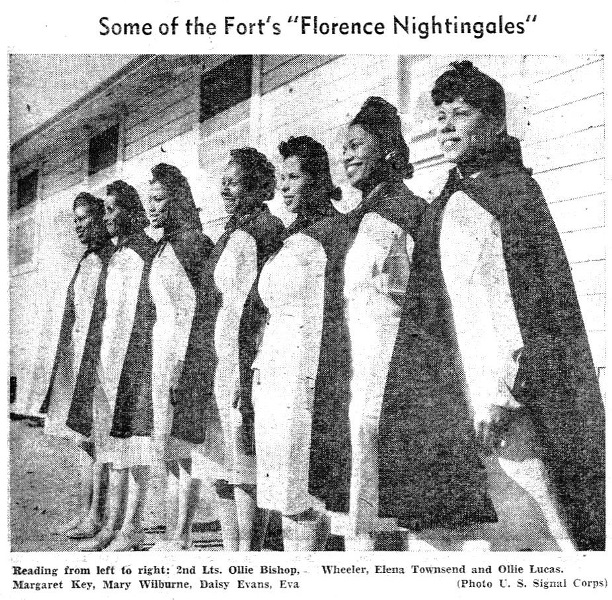
Before leaving Fort Huachuca, we are required to undergo a round of training for overseas postings. The drills on the rifle range will cover rolling over and not raising our heads to avoid getting shot. Live ammunition is used for the drill. We will learn how to get under barbed wire and how to get in and out of ditches. It sounds to me like the same type of training the soldiers receive.
After a three-day train trip across the country, we have arrived in New York City, back in the place my journey began. We will have ten days of processing, which will include physicals, immunizations for typhus and cholera, and I am sure plenty of briefings, covering everything from the need for secrecy to the importance of mosquito netting. Our packet of instructions say uniforms will be modified to include protective clothing for the type of climate we are destined for. The list includes fatigues, field jackets, field shoes, wool and cotton socks, mosquito head nets and mosquito gloves. The good news is we will have time for dinner in a restaurant and a night at the theater before we leave New York. Seems it will be a very long time before we will have a chance to enjoy these special treats again.
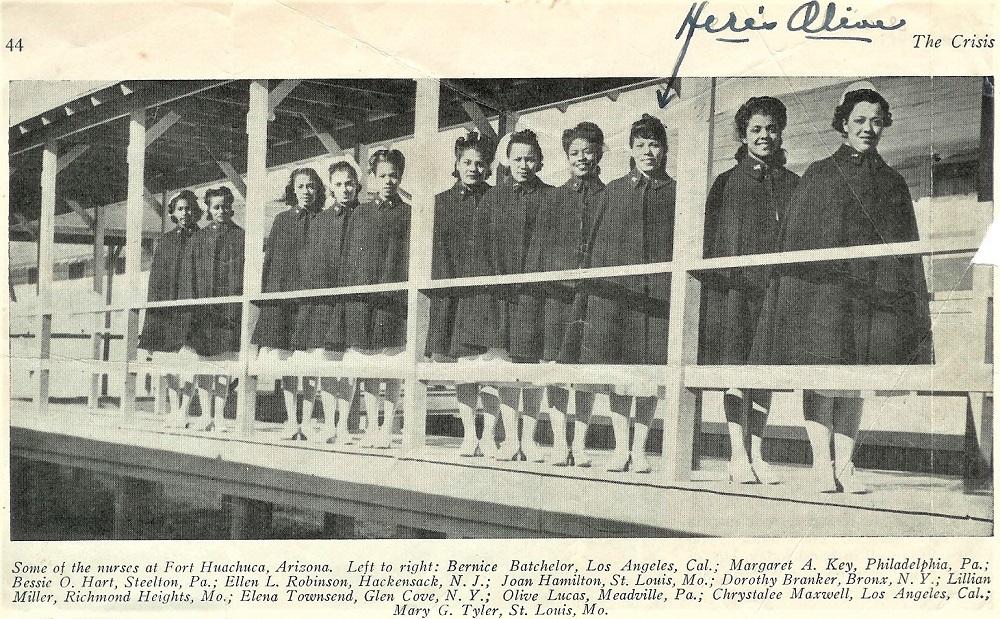
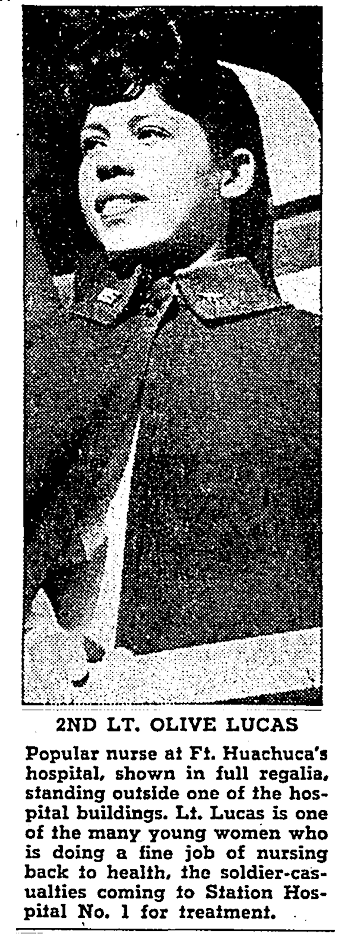
There is one more thing I have to do before leaving New York and that is contact my friend Wanita Davidson and ask a favor. During the time I spent at Hospital #1 in Fort Huachuca, there were three occasions when we were visited by reporters from African American newspapers and magazines. Each one of those publications was anxious to tell the story of this first of its kind, all black hospital on an army base. Many of the nurses were interviewed and our pictures were taken each time.
The last visit was from a young reporter named Langston Hughes who writes for the Chicago Defender newspaper. He is also a poet and writer, so it was wonderful to meet him. I need to ask Wanita to find a copy of those articles so I can send them to my family. I am sure she will be able to find them at one of the newspaper stands in Harlem. My family will be so proud to see me in uniform and being a part of something so important to the country. I think a daily journal is going to be the best way for me to keep track of all the things I am going to experience. I know it will be helpful when I do have time to write to my family and I am sure there will be plenty to tell.
|
August 24, 1944 – After being split into small groups we boarded the transport plane. I know I was not the only one filled with equal parts of excitement and nervous anticipation. Not sure what to expect, but I knew I was ready. When we boarded the plane, I did not realize that the distance we were to travel would require layovers in various places. Never in a million years did I think I would see the Pyramids, the Sphinx, Casablanca, Cairo and so many other interesting places. When we flew over the Holy Lands, it made those bible stories of my childhood become more than just stories told in Sunday School. One of the nurses was very afraid of flying and was thankful for days with heavy overcast skies so she didn’t have to see the ocean below. I was hoping for many days of clear weather, I didn’t want to miss a thing.
September 12, 1944 – After landing in Karachi, India, we have a few days to rest as guests of the 181st General Hospital before we begin our six-week attachment to the 48th Evacuation Hospital here. The climate in Karachi is unbelievable, it can reach 130 degrees in the day, with slightly cooler temperatures at night. I hope the mountains of Burma will be a little cooler.
|
September 17, 1944 – The 48th Evacuation Hospital officially opens next month, but we are here to help get everything up and running. Even before the official opening day, 900 of the 1000 beds are full. The 66 nurses are desperately in need of help. Some of the patients here were injured in plane crashes, others are suffering from “scrub typhus” and are some of the sickest. The majority of the patients are Chinese, who are suffering from battle wounds and malaria.
Life at the 48th Evac is certainly interesting. We are living in British tents, four to a tent, a tent that we share with frogs and lizards. We have done our best to make it a temporary home. We have covered boxes and crates with colorful cloth from the Indian Bazaars. In Burma, our housing will be Bashas, which are huts made of bamboo and grass. We plan to go back to the Bazaar to buy some inexpensive bamboo chairs and tables to take with us before we leave Assam because travel on Ledo Road is dangerous, so we will not be able to return to Assam before we leave for Burma. The six weeks we have spent with the 48th Evac have been a good opportunity to learn how to set up and open a hospital. I imagine our location in the mountains of Burma will be different, but I feel more confident in understanding what is involved in the operation of the hospital.
October 18, 1944 – Our full unit is in place, we move out tomorrow for Tagap, Burma. I know nothing about Burma, but in talking with soldiers working on Ledo Road, they tell me that Tagap is near the top of a 4, 500-foot peak of the Patkai Range. Wearing full field uniforms, we will travel by truck convoy up and over the Ledo Road for 80 miles into northern Burma.
October 19, 1944 – It has been a long day. We arrived here at the 335th Station Hospital in Tagap, Burma late this afternoon, tired, dusty and more than a little nervous. Before nightfall, we needed to put up our cots and mosquito bars in hopes of getting a good night’s sleep. After sorting things out, we had a short meeting and a supper of C-Rations.
October 20, 1944 -The morning makes clear just how bad the conditions are here. This site was a former headquarters. It needs much work on the grounds and many repairs are needed for the buildings. Most of them are made of bamboo and some are infested with rats and will have to be burned. It looks like some of the buildings can be repaired and made somewhat livable. I have never seen so many blood-thirsty mosquitos, thank goodness these are not the malaria carrying variety of insect. The soldiers building Ledo Road told us to be sure to use the mosquito bars because they are good protection from the rats. Well, at least so far, no one has seen any snakes.
December 1944 – After several months of the area being burned, cleared, scraped and drained, it has been possible to put many of the buildings on concrete foundations, which makes for much better working conditions. All of us were eager to set up our Bashas. The colorful cloths and throw rugs from the Indian Bazaar in Assam and the bamboo chairs and small tables have made it possible to once again create a comfortable space for us to call home.
December 23, 1944 – Two days before Christmas, the 335th Station Hospital is now open.
| Notes – Overseas training, African American Soldier at Fort Huachuca, Ariz, 1892-1946, Stevenn D. Smith, pg. 112 ; – Travel orders, Unit Citation, Campaign Participation Credit Register, Dept of the Army, Heritage & Educ Center ; -48th Evacuation Hospital, G.I. Nightingales, Barbara Brooks Tamblin, pg. 162-163 ; -335th Station Hospital, Double Victory, Cheryl Mullenbach, pg 135 – 136. |
Part 4 – Burma Journal – December 25, 1944 to March 31, 1945
December 25, 1944
Here we are at the 335th Station Hospital in Tagap Burma. The hospital is up and running with 100 beds. The location in the middle of the jungle required several months of hard work spent clearing the land and repairing or replacing the dilapidated buildings. Our compound is made up of a medical laboratory, pharmacy, operating rooms, patient rooms, and mess hall and living quarters. We have a water system that carries water from high in the mountains to the hospital and there is a drainage system to help manage the flooding that occurs during the rainy season. The surgical buildings have concrete foundations and are powered by generators.
Our Bashas (makeshift shelters) are set up with two to a room divided by a bamboo wall to separate us from the nurses sharing the other room. The windows are made of Bamboo and we can open and close them which is important during the strong winds
|
Homesickness has not been much of a problem, but I am feeling extremely homesick at the moment. Christmas has always been my favorite time of year. Memories of Christmas past at home with my family make me nostalgic. I have good reason to be homesick, I haven’t seen my folks since June 1st and that was only for a ten-day leave. Ten days goes by so quickly, especially when I knew that I would soon be posted overseas. Arizona is a long way from home, but I was pretty sure the next stop for me would likely be somewhere on the other side of the world, and here I am, in the Himalayan Mountains of Burma. One requirement to survival in the Army is the ability to adapt, and I have learned to be good at that.
The weather here is cold, with biting winds and heavy wet fog. But the nasty weather has not dampened our holiday spirits. Thanks to the Special Services unit, we have trees and decorations for our makeshift club. All of us have been busy making our own decorations. It turns out that empty Plasma cans can be made into lovely stars for the tree. Our club is one of the original buildings that still needs to be renovated, but today it looks almost like a Christmas scene from home. Soldiers from the nearby Ordinance and Engineering units are coming to celebrate with us. The buffet table is filled with rations from the PX and the special treats from home that everyone brought to share.
January 1945
Our meals are served in the mess hall. There is plenty of food, but it gets very monotonous. Sometimes the mess officers travel more than 200 miles in a day to bring back enough food for several days. Their trips often result in meals that include things like fresh vegetables, eggs, chicken and fish, which are greatly appreciated by all of us. We have plenty of money and no place to spend it, so we pool our resources to make things more comfortable in what can be less than a comfortable place.
Our staff consists of 16 physicians and 16 nurses. Our patient load consists of Negro and white Americans, as well as Indian and Burmese laborers. Routine daily care usually includes treatment for colds, Malaria, pneumonia, broken bones, and sprained backs. Our patients stay with us until they are able to return to duty or are stable enough to be evacuated to a general hospital. During the month of December, we had 50 cases of malaria, one case of typhus and the rest were traumatic injuries resulting from jeep and truck accidents along Ledo Road.
The light patient census at the beginning has made it possible for our nurses to work short six-hour shifts except for the days when storms wash out the roads to our quarters which can result in a 24-hour shift. Currently, there is no need for night nurses. The light schedule allows all the personnel to take advantage of the courses offered by the Armed Forces Institute. Both enlisted and officers are taking part in the classes. Typing is the most popular class for the nurses. My roommate and I are competing to see who gets the fastest typing speed. While we have the time, we are making some of the surgical supplies that are needed. We sew things like caps, surgical masks, and sheets. Since I am not handy with a needle, I am painting the cabinets for the wards. Everyone is helping in whatever way they can.
February 1945
The construction of the Ledo Road and the casualties resulting from that 1000-mile project has resulted in a greatly increased patient load. The 335th Station Hospital is the treatment center for all personnel building the road. The injuries that occur with soldiers using heavy equipment in treacherous weather conditions create the major portion of our patient census. The proudest moment for all of us on the medical staff was Dr. Strickland’s refusal to segregate the hospital and reserve beds for white soldiers. Dr. Strickland cited his belief that all soldiers equally shared pain, suffering, and hope throughout their time engineering a difficult military route, and thus, all deserve equal care and medical attention regardless of skin color or ethnicity.
Our patient census has now increased enough to require three eight-hour shifts. The night nurses work two-week assignments. When corpsmen are available, they assist us by treating routine cases, which frees the rest of us to treat patients with more serious issues. In addition to the Ledo Road patients, we have had a very busy four-week period where we treated Chinese troops who were fighting in Burma. These soldiers had so many wounds, some from artillery, tank, and land mines. With only 16 nurses to treat patients, it quickly became clear that we all have to step up to assume greater responsibility. We are quickly learning the signs and symptoms required to identify different tropical diseases. The surgical nurses are dressing wounds without the presence of the doctors and the medical nurses are instituting intravenous fluids and routine courses of medication on our own.
Penicillin is a new drug that we are using for the first time. We have to account for every drop used. It is used as a very effective treatment for syphilis, but it certainly has been life saving for serious wounds. Here we are using the newest in medicine, but at the same time, we are finding ways to combat the ever-present mold and mildew. We have been using the metal cans that our butter comes in to store our surgical supplies. Although not very fancy, the cans get the job done. As a group, we have stayed pretty healthy in spite of all we deal with. We make sure to take our Atabrine to protect us from malaria. The only side effect of the medicine is that it makes your skin look yellow. One of the nurses even used it to dye the curtains in her Basha. They are a lovely shade of Canary yellow.
March 1945
A severe storm came through last night and demolished our movie theater and tore the roofs off most of the other buildings. By the time the storm was over, things looked worse than they did when we first arrived. Once again, the Army units responsible for the site worked night and day to put the place back together. The wards and living quarters have been rebuilt and now are more convenient, as well as being larger and more airy. Our new theater was designed by our Special Service officers and built by the enlisted men. All the nurses are using spare time to make new curtains and the Indian and Burmese laborers are doing the painting. The building has a stage with dressing rooms below. There is a large screen with a wooden (not bamboo) roof over the seating area. During construction of the new theater, the Recreation Committee set up a screen next to the dental building so we didn’t have to miss our regular schedule of three shows a week. The Indian Mahuts, (Mahuts are the Indian Elephant workers who are helping with construction of Ledo Road) always come to the movies, they usually arrive riding their elephants – a sight I will never forget.
Recently, the more moderate temperatures make it possible to continue with construction of buildings that weren’t considered a priority at opening. Our makeshift club has a fresh coat of paint, a bar has been added and there is now a library which also serves as a game and reading room. We are isolated here in the mountains, but thanks to the Recreation Committee we have many activities. There is volleyball, tennis, ping-pong, horse shoes, basketball, and baseball. We even get to travel to softball and basketball games, even though some of them are a hundred miles away. Twice a month, we have Saturday evening dances in the officer’s club. The Recreation Committee events and the shows from USO and G.I. programs really help keep morale high for all the staff at the 335th. We have had a few mild days and it has been nice to be able to wear our seersucker uniforms, but we still wear slacks under them, as part of the malaria protection protocol. Six of our nurses are on rest leave in India for 15 days and when they return the rest of us, in groups of two or four, will be going on rest leave as well. I am really looking forward to someplace warm and sunny.
| Notes: Dec 1944 – Double Victory, Cheryl Mullenbach, pg. 133–135, G.I. Nightingales, the Army Nurse Corps in World War II, Barbara Brooks Tomblin, pg. 163 ; Jan 1945 – G.I. Nightingales, the Army Nurse Corps in World War II, Barbara Brooks Tomblin, pg. 163-164 ; Feb 1945 – No Time for Fear, Diane Burke Fessler, pg. 56, 58, 106, 108, G.I. Nightingales, the Army Nurse Corps in World War II, Barbara Brooks Tomblin, pg. 168 ; https://www.pacificatrocities.org/blog/black-history-month-recognizing-african-american-efforts-in-building-the-ledo-road ; A History of U.S. Army Nurse Corps, by Mary T. Sarnecky, Univ of Pennsylvania Press (1999) pg. 209 ; Mar 1945 – Historical Report, Army Nurse Corps, 30 July 1945, Lt. Daryle Foister, 383rd & 335th Station Hospital, Tagap, Burma pgs. 1 – 8. |
Part 5
April 1945
Winter is not over and spring is not yet here. The severe weather conditions in our “hospital in the sky” are beginning to wear on all of us. The good news is that I am in the next group granted rest leave. Sylvia Lasser is a nurse who just returned from leave in Darjeeling, India. While on leave, she stayed at Hotel Mount Everest. She told us about spending days playing tennis, horseback riding, and going to dances with American and Canadian flyers based in the area. I have never played tennis or ridden a horse, but I can dance. I can’t wait to try all three. Last week we were honored by a visit from the Theater Surgeon. We were all proud to learn that he was pleased with the work we were doing and the progress we have made.
|
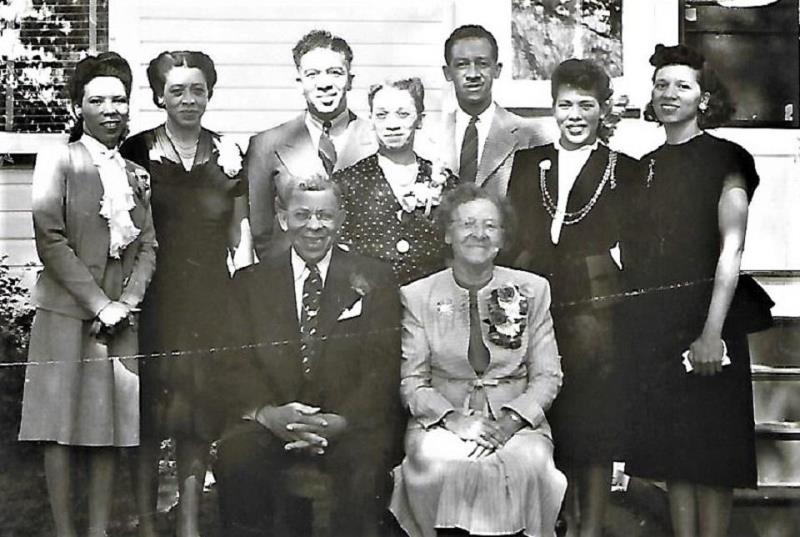
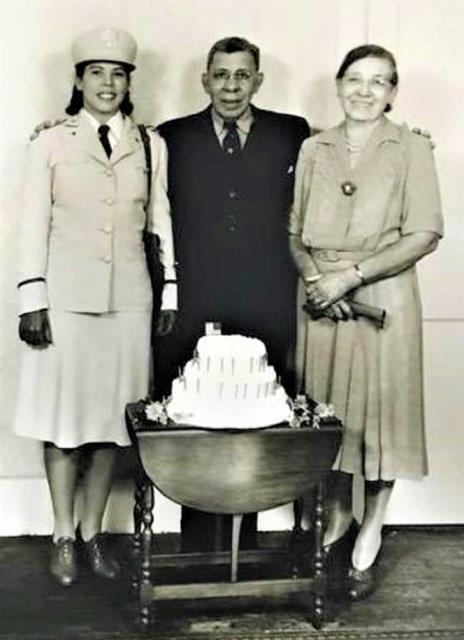
| Family photo of Olive with her parents at their 50th wedding anniversary. Front row, left to right, are Gladys, Marguerite, Wilbert, Ethel, Kenneth, Olive, and Marian. Front row, left to right, are John and Mary Lucas. |
May 1945
My rest leave was wonderful and I enjoyed all of it. But, now I am back at the 335th and up to my elbows in-patient care. It seems like the change of seasons has resulted in more patients with more serious issues. We have a patient with scrub typhus. I don’t think I have ever seen a patient who was sicker than this soldier. He is on the mend and expected to survive. I am just grateful that we are able to keep him isolated enough that it has not spread through the wards. The visit from the Surgeon General has resulted in each of the nurses at the 335th being promoted to 1st Lieutenant. We believe our promotions are well deserved.
July 1945
Our patient census has dropped significantly over the summer. With the patient census this low, it makes me concerned about the rest of our tour here. We are living in harsh conditions and that is okay when we are busy doing what we are trained to do, but the thought of slow times with little work is very worrisome. My roommate, however, assures me that with our daily load of injuries from construction of Ledo Road we will surely be busy for many more months. We have been told that the goal for the Ledo Road is to connect India, China, and Burma and allow supplies to move more quickly to China where they are needed for the fight against Japan. That being the case, she may be right in her prediction.
September 1945
Word has come down that we are beginning the inactivation of the 335th Station Hospital.
Our job is no longer caring for patients, our job is now to take apart the hospital we put together just a year ago. At least this will keep us busy now that our patients have been moved on to their next medical facility. We are directed to inventory, box up, and label all hospital equipment and medical supplies. Rumor has it that some of the hospitals in other areas have done that huge job of packing up only to have those boxes and crates of supplies dumped in the ocean. Apparently, it would cost too much to ship it all back to the States. I hope the rumors are wrong, all of these supplies would be greatly appreciated by the local hospitals here in Burma, as well as in India.
Packing is not the only thing occupying our time, thoughts of home are filling our days. Going home, there is so much to consider. I will be so glad to be back home, glad to see my family again, glad to resume my life and career back in New York. This past year has been such a challenge, sometimes a little frightening, but I don’t know that I have ever learned so much in such a short period of time.
I never imagined that I would be a part of a group where I would have the chance to work with people from all over the world. Working as a team, being a valued member of the team, and being recognized for my particular skills has given me renewed confidence in my own abilities. One thing for sure, I intend to take advantage of the G.I. Bill to get my graduate degree. I am sure I will continue in nursing and I believe my Army experience has made me a much better nurse and that should make me qualified for jobs that will ensure career success, at least I hope so.
October 1, 1945 – 335th Station Hospital is inactivated. The personnel will leave from Karachi, India by ship, the General Morton. We expect to arrive in New York Port of Embarkation by Oct 23, 1945.
Ledo Road
Construction began in 1942 with 15,000 American troop members, 60% being African American. Along with the Black troop members, another 35,000 soldiers consisting of Indian, Chinese, and Burmese nationals, assisted in the construction of the road. The goal was to have the road begin in Ledo, India, cross over the Patkai Mountains (where passes were as high as 4,500 feet) and end at Kunming, China. By 1944, the road stretched 1,726 kilometers (1,072 miles), with 1,033 kilometers (642 mi) in Burma, 632 kilometers (393 mi) in China, and the remainder in India.
Epilogue
Olive was discharged from the Army Nurse Corps in 1945. After a visit home to see her family, she returned to New York and resumed her nursing career. She took advantage of the G.I. Bill and in 1949 she received her Bachelor of Science in Nursing at the age of forty-one and in 1951 she received her Master’s in Nursing Education at the age of forty-three, both degrees were from New York University.
Newspaper articles about her promotions over the years make it clear that she was successful in her nursing career. In May 1949, Olive is mentioned in a Column called “Bill Chase, Around Town” that ran in “New York Age Newspaper” on May 14, 1949. The columnist relates his story of Olive, “I suppose I have more than the usual right to be proud of the fact that Olive Lucas who holds a BS in public health was made assistant last Friday to the supervisor of nurses at Welfare Island Dispensary. You see Olive was my nurse in Harlem Hospital back in 1933 when I was run over and almost killed by a truck because I was foolish enough to go in for the roller-skating craze then in vogue.”
|
On Nov 20, 1954 the ‘New York Age Defender Newspaper” ran a story about Olive,“Harlem-Trained Nurse Gets City Hospital Job.” The story explains that Olive had just been named the first Negro Nurse to take over the Nurse Coordinator and Home Care department at City Hospital on Welfare Island on November 16, 1954. It is interesting to read how women are portrayed in newspaper articles of that time.
After her retirement, Olive was active in the National Association of Colored Graduate Nurses.
Apparently, she was also very active in fighting city hall. This was a time of Urban Renewal projects in major cities. Her ride on the bus to city hall often involved conversations with other riders to let them know they needed to fight to prevent many of the neighborhood buildings being torn down in the name of progress.
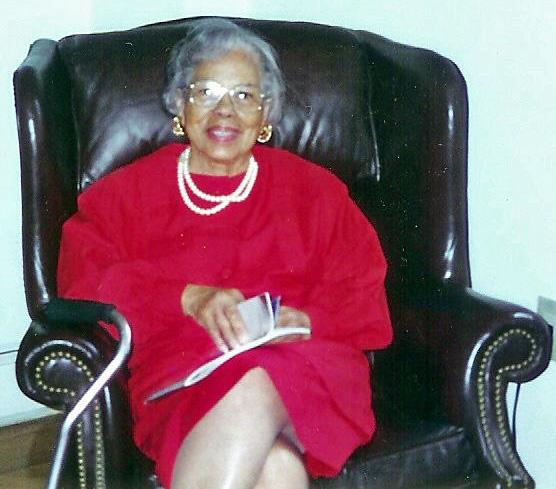
Olive returned to her hometown of Meadville, Pennsylvania after having a stroke. She recovered well from the stroke thanks to the care from her family. She spent her final years at Wesbury United Methodist Community, along with her brother, my dad Kenneth Lucas. Olive took an active part in the community and she especially enjoyed the music programs.
Olive was born on Halloween in 1908. The last year of her life she spent looking forward to her 100th birthday party. Sadly, she died 9 days shy of her 100th birthday. Her funeral was held on Halloween 2008. Her family and friends sang Happy Birthday and passed out bags of her favorite candy. I am sure Olive would have loved it.
|
|
|
|
|
|